

Twice As Far, a Quarter As Bright
Hand it an ordinary photograph and it takes the picture again at night on a direct flash — where light falls off with the square of distance, so the near thing is blown out, the far thing is black, and only the background keeps the street's colour. Two fields.
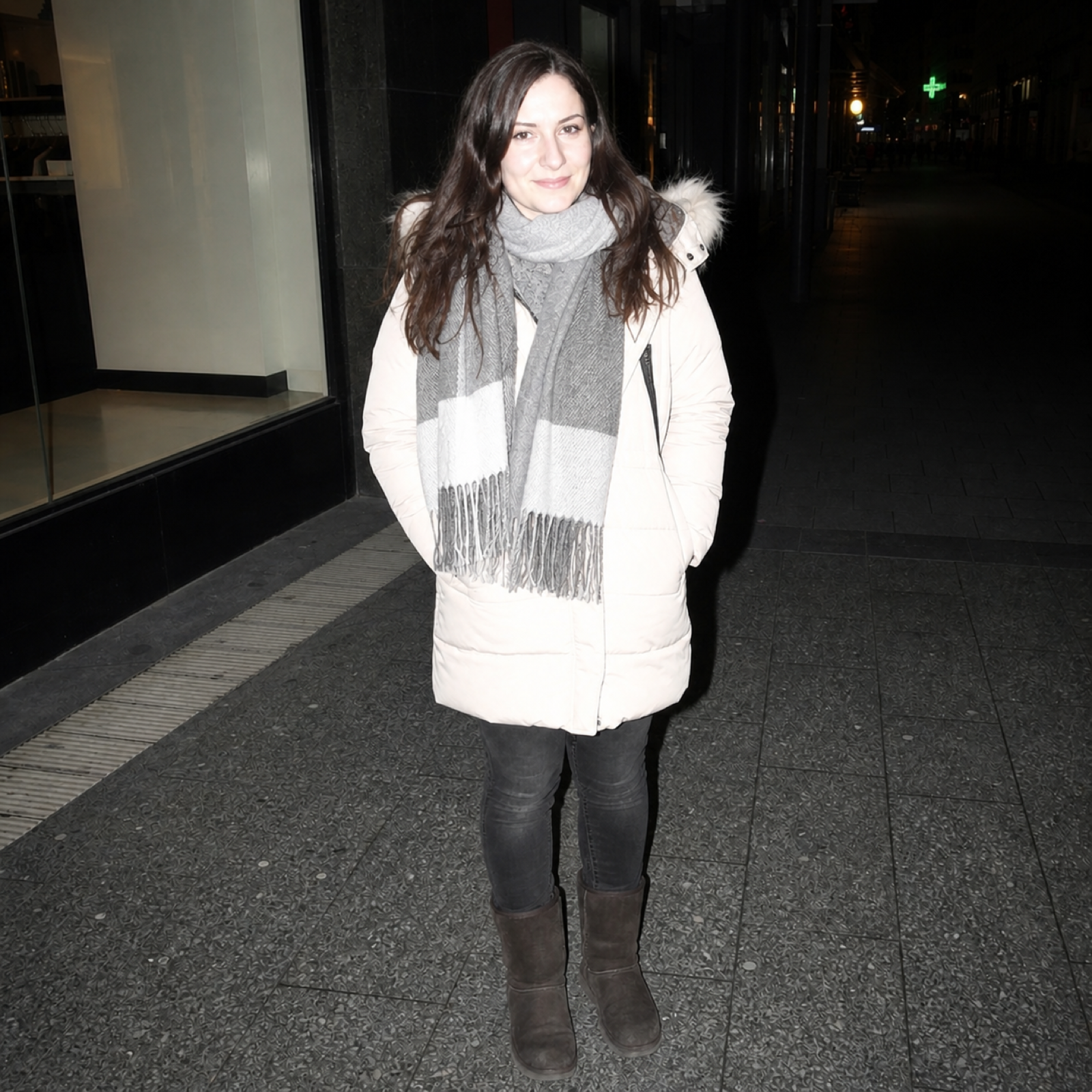



One treatment, two different photographs. A woman on a pavement and a bowl of noodles on a table — one falloff measured in paces, one measured across a restaurant, and both split into a neutral foreground and a coloured distance.
Stating the inverse-square law rather than asking for a flash look does the whole job. In both runs the nearest named thing is close to blown out, the fall away from it is steep rather than gentle, and the furthest named thing is black or lit only by the ambient: the shopfronts vanish behind the coat, the far tables vanish behind the bowl. The colour split arrives with it — neutral where the flash reaches, orange sodium and a green sign surviving only past its range — and so does the hard shadow just outside her outline on the shop window, which is what a light at the lens does. The face came through as the same face. Two things to check in your own runs. Things that go dark tend to go missing: the pedestrians further down the street are absent rather than dim, and while that is close to what the physics gives you, it is still a change to what is in the picture. And the food run rearranged the noodles and moved a slice of beef while keeping the bowl, the spoon and the table exactly — loose contents shift more than solid objects do, so compare them before shipping.
Generated for this library
Input
  Nearest     the woman's face and the front of her coat
  Furthest    the shopfronts down the street
  Ambient     orange sodium streetlights and a green
              convenience-store sign further down
  Photograph  street.png (1254 x 1254)

Returned   1 image · 1:1 · the same woman, at night, on a flash

falloff    steep - the coat is close to white, the
           pavement is gone within a few paces, the
           shopfronts are black
shadow     hard and close, thrown onto the shop window
           just outside her own outline
colour     split - neutral where the flash lands, a
           green sign and sodium orange surviving only
           in the far dark
subject    the same person: features, hair, scarf, coat
           and boots all unchanged, lit flat
street     the pedestrians who were down the road are
           gone rather than dark
words none, in any scriptYou fill in 2 fields — the braced lines at the top. Everything below them is fixed.
- 1What is nearest the camera, and what is furthest
- 2What is lighting the place, apart from the flash
Twice As Far, a Quarter As Bright
What this makes
Hand it an ordinary photograph and it takes the picture again at night on a direct flash — where light falls off with the square of distance, so the near thing is blown out, the far thing is black, and only the background keeps the street's colour. Two fields.
You are given ONE ordinary photograph. Return ONE image: the same subject, photographed again in the dark with a flash on the camera. Follow every line. Replace only the FIELDS block; everything after it is fixed.
First — do you have the photograph and the fields?
Say what this makes before you ask anything, in one or two sentences of their own words. Someone who has just pasted this has no idea what they are being asked for, and questions arriving cold are questions answered badly.
If no photograph is attached, stop and ask for one. This re-photographs a particular thing, so there has to be a picture of it.
If either field below still has braces around it, stop and ask. Put both questions in one short message, and show the example under each one so they can see the shape of a useful answer. Wait for the replies, then work. Never fill a brace yourself.
Ask in whatever language they are writing to you in. Translate the questions and the examples; do not make someone read English to tell you what they want.
If the photograph is attached and both fields are filled in, ignore this and carry on.
Fields — replace these two lines only
- What is nearest the camera, and what is furthest: {two things in the picture}
- What is lighting the place, apart from the flash: {the ambient lights and their colours}
The law everything else follows from
The object is untouched. The photograph of it is taken again.
Everything about the picture changes: the hour, the light, the exposure, the colour. Nothing about the thing in it changes. Same shape, same colour of its own, same markings, same wear, same arrangement. It is that subject, photographed at night by somebody standing where the first camera stood.
Light falls off with the square of the distance
This is the whole rewrite, and it is one line of physics.
The flash is a small light at the camera. Its brightness on a surface drops with the square of how far away that surface is. Something twice as far away is a quarter as bright. Three times as far is a ninth. Nothing else about a flash photograph matters as much:
- The nearest thing the first field names is nearly blown out — the brightest part of the picture, close to white, with its texture starting to disappear.
- A pace or two behind it, everything is markedly darker. Not softly shaded: darker by a lot, and visibly so within a short distance.
- The furthest thing the field names is nearly black, or lit only by the ambient light.
- The fall is smooth and it is steep. A subject's own face is brighter at the nose than at the ears.
If the whole frame is evenly lit, this has not been done.
The light is at the lens
- Shadows fall directly away from the camera, so most of them are hidden behind the things that cast them.
- Where something stands close to a wall, its shadow appears just outside its own outline — hard-edged, dense, and offset by very little.
- No modelling. Faces and objects are lit flat from the front: little shading across a cheek, the form carried by the falloff into the background rather than by shadow on the subject.
- Speculars point back at the camera. Wet pavement, glass, glaze, varnish, an eye — each takes a small hard highlight, and on a face the catchlight sits dead centre in the pupil.
The colour splits in two
- Where the flash reaches, the colour is the flash's — neutral, and it neutralises whatever the ambient light was doing there.
- Where the flash does not reach, the ambient colour survives: the orange, the green, the blue the second field names.
- The boundary between the two runs across the picture at the distance where the flash gives out, and it is one of the most recognisable things about this kind of photograph.
The camera is small
- Noise in the dark parts, and more of it the darker they get.
- Deep depth of field: the near and the far are both about equally sharp, and the far is simply dark rather than blurred.
- Some highlights clip and stay clipped.
- No treatment. No grain overlay, no vignette, no light leak, no date stamp, no film border, no filter. These are the properties of a small camera, not a look applied to a good picture.
The subject does not change
- Same colour of its own, under a different light. A green sign further down the street does not repaint it.
- Same shape, same proportions, same markings, same wear, same arrangement of parts.
- It may be seen from a slightly different distance, because somebody stepped closer to use the flash — but it is the same thing.
Never
- Text, numerals, a date stamp, a caption or a watermark anywhere, in any script.
- An even, well-balanced exposure across the whole frame.
- Extra people, props or lights that were not in the photograph.
- A border, a frame, a polaroid edge, a mock-up.
- Any change to what the subject is.
What it should read as
A picture taken quickly in the dark by somebody who did not think about it — near thing burning, far thing gone.
The whole template, in one piece. The steps below are the entire workflow.
How to use it
- Copy the whole template with the button above.
- Attach the photograph and paste the template in the same message.
- Replace the two FIELDS lines. Name the nearest and furthest things from the picture itself, so the falloff has two anchors.
- Check the near thing first: if it is not close to blown out, the flash was treated as a mood rather than a light source.
- Then check the background. If the whole frame is evenly lit, the falloff did not happen and it is worth another run.
What you swap
- What is nearest the camera, and what is furthest
- the woman's face and the front of her coat are nearest; the shopfronts down the street are furthest
- What is lighting the place, apart from the flash
- orange sodium streetlights and a green convenience-store sign further down
Before it runs
- A photograph, attached to the message. This takes a particular picture again; there is nothing to re-shoot without it.
- Depth in the picture. A flat wall photographed head-on has no distances for the falloff to act on, and the result will just look bright.
- A near thing and a far thing you can name. The whole effect is a ratio between two distances, and naming them is what makes it a measurement instead of a mood.
- Acceptance that things will disappear. Anything far enough back goes to black, and that is the physics rather than a mistake.
When to reach for it
When something needs the look of a picture taken at night on a small camera: a gig, a menu, a zine, a late shot for a feed. Templates in this genre ask for a nostalgic flash photo look and hand back an evenly lit picture with a bright spot in it, because the falloff — the thing that actually makes a flash photograph — is never stated.
What changes
- One photograph in, one flash photograph out — same subject, taken again in the dark.
- Brightness falls off with the square of the distance, so what is nearest is nearly white and what is a few paces back is nearly black.
- The ambient colour of the street survives only where the flash cannot reach, which splits the picture in two.
- Shadows land hard and close, thrown away from the camera, because the light is at the lens.
- One image, no grain overlay, no date stamp, no border.
Pairs with
- A Grade Moves No ShadowHand it a snapshot and it comes back graded — a named contrast curve, a named colour split, halation and grain — with every object, every shadow and the whole framing exactly where they were. Two fields.
- A Hole Has No Focal PlaneHand it a photograph and it takes the picture again through a pinhole — no lens, so nothing is ever truly sharp and nothing is ever more blurred than anything else, with the corners falling away because of simple geometry. Two fields.
- A Line at a Constant HeightHand it a photograph and it comes back as contour lines — every line a closed loop at one depth, none of them crossing, none of them stopping in mid-air, with the spacing doing all the shading. Two fields.