

A Line at a Constant Height
Hand it a photograph and it comes back as contour lines — every line a closed loop at one depth, none of them crossing, none of them stopping in mid-air, with the spacing doing all the shading. Two fields.
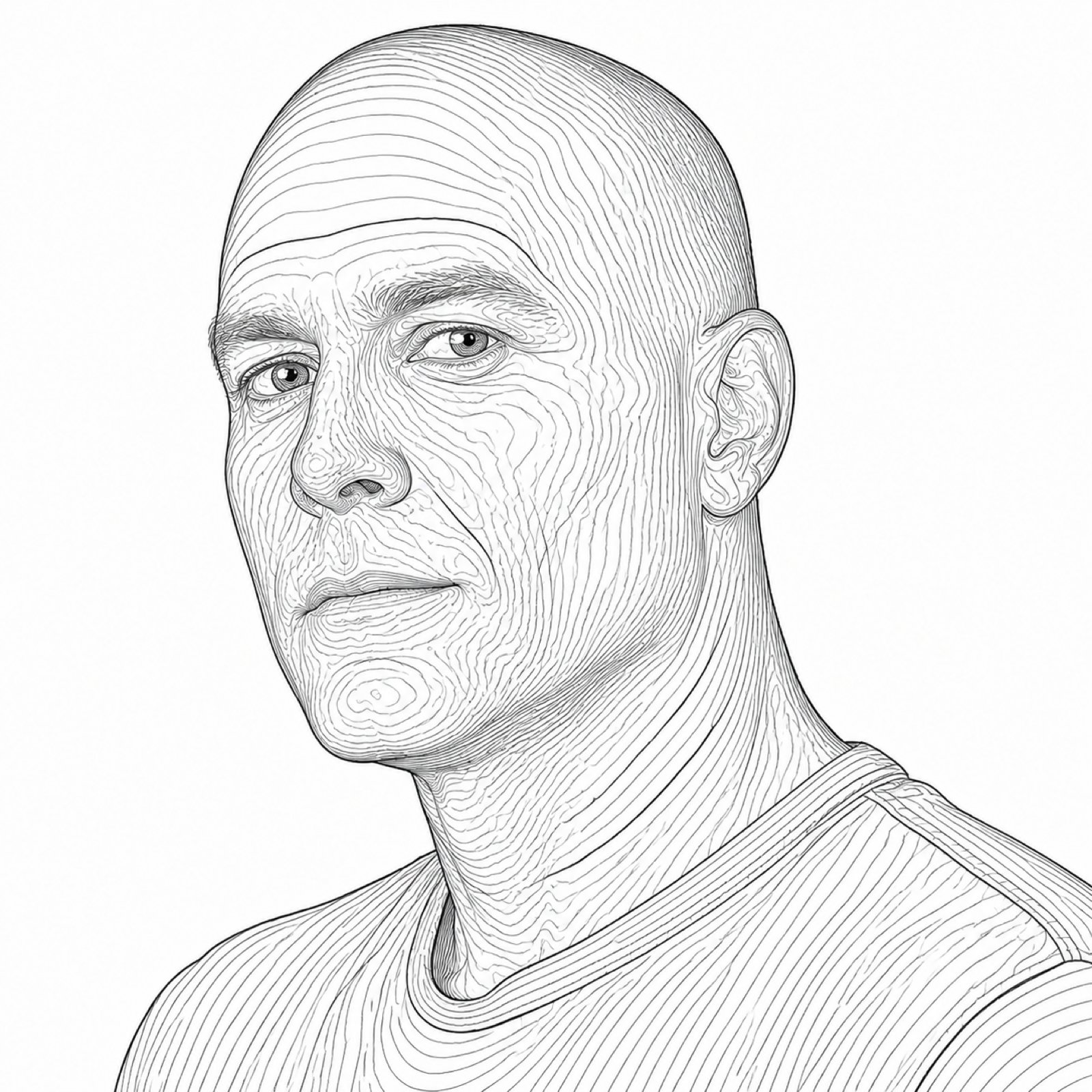

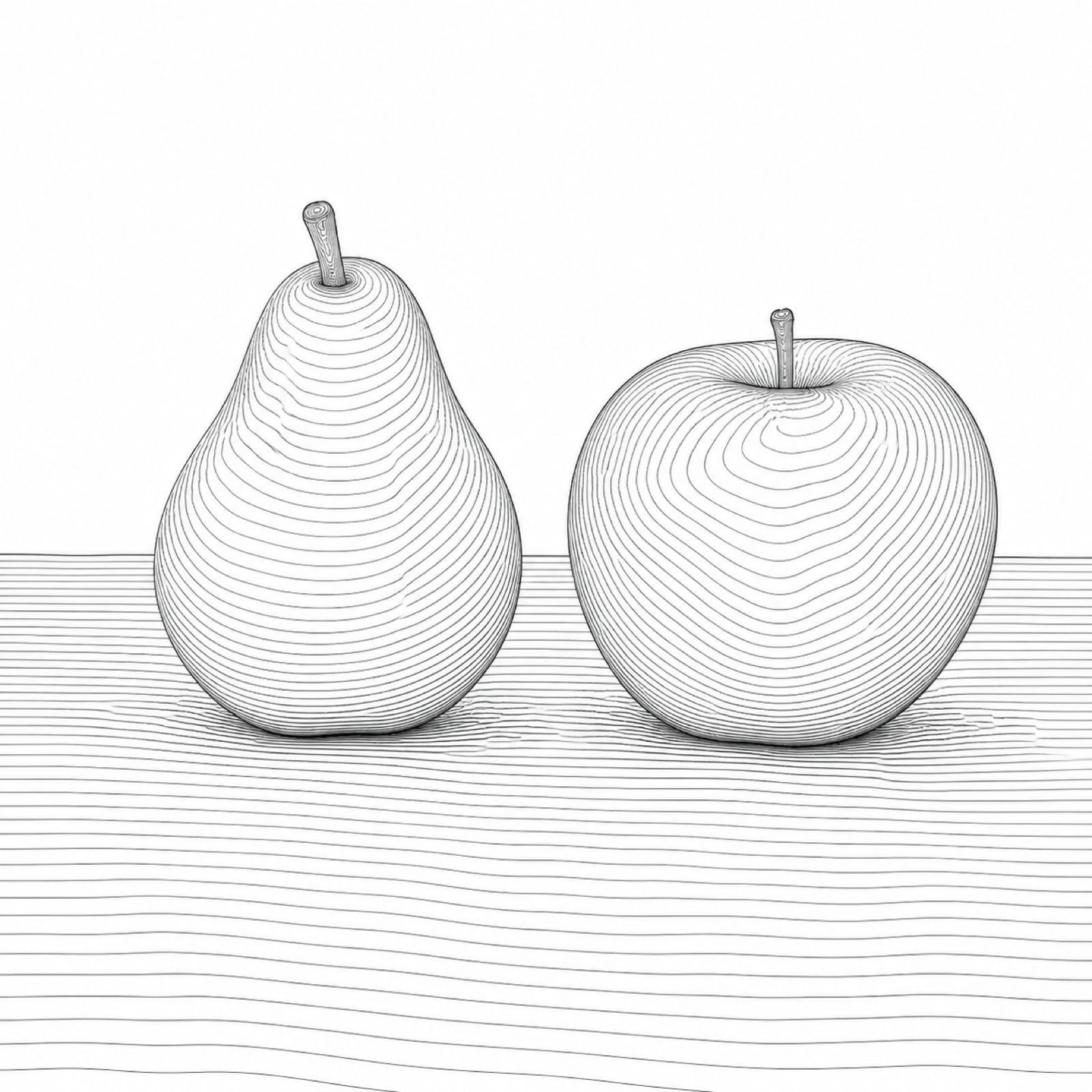

One treatment, two different photographs. A head, whose form is all subtle turns, and a pear beside an apple, whose form is not — the fruit is where the rule holds completely and the face is where it frays.
Half of this binds outright and half of it resists, and the resisting half is worth more than the success. What works: no two lines cross anywhere in either run, the spacing genuinely carries the steepness — crowding where a cheek turns away, opening across a forehead — and there is no grey, fill or hatching in the picture. The pear and apple run is very close to correct, with clean nested loops on each fruit and the table lines running off both edges of the frame. What fails is the rule that a line must close on itself or leave the picture. The first attempt ended lines in mid-air all over the cheek. I added a construction rule telling the run to draw the smallest loop first and each next one enclosing it, and to treat a short stroke that goes nowhere as hatching — which changed the character of the drawing, so the ear and eye socket now resolve into proper closed rings. It did not fix the terminations. Counting endpoints on the identical crop of cheek, before the rule there were 152 line-ends per thousand pixels of line and after it there were 195. Stating the requirement positively, and even as a procedure, was not enough. Use this on things with simple form, and expect a face to fray.
Generated for this library
Input
  Nearest     the tip of the nose
  Furthest    the back of the shaved head
  How many    about twenty-five lines between them
  Photograph  portrait.png (1254 x 1254)

Returned   1 image · 1:1 · the head as contours

crossings  none anywhere in either run
loops      proper nested rings round the eye socket
           and the whole ear
spacing    crowds where the cheek turns away, opens
           out across the forehead
form       the head reads as sliced rather than
           hatched
endings    still there - short strokes that stop in
           mid-air on the cheek and jaw, and by
           measurement more of them than before
words none, in any scriptYou fill in 2 fields — the braced lines at the top. Everything below them is fixed.
- 1What is nearest the camera, and what is furthest
- 2How many lines between them
A Line at a Constant Height
What this makes
Hand it a photograph and it comes back as contour lines — every line a closed loop at one depth, none of them crossing, none of them stopping in mid-air, with the spacing doing all the shading. Two fields.
You are given ONE photograph. Return ONE image: that photograph drawn as contour lines. Follow every line. Replace only the FIELDS block; everything after it is fixed.
First — do you have the photograph and the fields?
Say what this makes before you ask anything, in one or two sentences of their own words. Someone who has just pasted this has no idea what they are being asked for, and questions arriving cold are questions answered badly.
If no photograph is attached, stop and ask for one. This describes the form of a particular thing; there is nothing to slice without it.
If either field below still has braces around it, stop and ask. Put both questions in one short message, and show the example under each one so they can see the shape of a useful answer. Wait for the replies, then work. Never fill a brace yourself.
Ask in whatever language they are writing to you in. Translate the questions and the examples; do not make someone read English to tell you what they want.
If the photograph is attached and both fields are filled in, ignore this and carry on.
Fields — replace these two lines only
- What is nearest the camera, and what is furthest: {two points on the subject}
- How many lines between them: {a count}
The law everything else follows from
Everything about how the subject is drawn may change. Nothing about what is in it may.
The rendering becomes a set of slices. What is in the picture does not move: same subject, same angle, same arrangement, same framing, same relative sizes. It is that photograph, contoured.
A contour is every point at one depth
This is the whole rewrite, and everything below is arithmetic.
Imagine slicing the subject with a stack of planes parallel to the picture, evenly spaced from the nearest point named in the first field to the furthest. Each line in the drawing is where one plane cuts the surface. From that single definition:
- No two lines ever cross. A place on the surface has one depth, so it can be on one line only. A crossing is impossible, not untidy.
- No line branches. For the same reason: a fork would mean one point at two depths.
- Every line closes on itself or leaves the picture. A slice through a solid comes back round. A line that simply stops in the middle of the frame cannot exist.
- A line may be several separate loops where the plane cuts a shape more than once — either side of a nose, both sides of a handle. That is correct, and they still do not touch.
- Nested loops mean the surface is rising or falling toward that point. A small loop inside a larger one is a peak or a hollow.
If any two lines in the result touch, cross, merge or fork, the drawing is decoration.
Draw them from the inside out, one closed loop at a time
Work in the order the slices come. Start at the nearest point the first field names and draw the smallest loop around it. Then draw the next loop, enclosing the one you just drew. Then the next, enclosing that. Carry on until you reach the furthest point.
- Finish each loop before starting the next. Come back round to where you began. A line you have not closed is not a contour.
- A loop only ends early when it runs off the edge of the picture, and then it must leave the frame cleanly rather than fading out.
- Where the surface splits, one loop becomes two, and both of them close. They do not join and they do not touch.
- Never lift the pen in the middle of a form. If you find yourself drawing a short stroke that goes nowhere, you are hatching, and hatching is not what this is.
Spacing is the only shading
- Lines crowd where the surface turns away from the camera steeply — the side of a cheek, the shoulder of a pear.
- Lines open out where the surface faces the camera — a forehead, the flat top of a table.
- A surface exactly edge-on has lines so tight they merge into a dark band. That band is the silhouette, and it is the darkest part of the picture.
- There is no other shading anywhere. No grey, no fill, no hatching, no stipple, no gradient. Ink on bare ground.
The lines are all the same kind of thing
- One weight for all of them, because every line means the same thing. Do not thicken the near ones.
- Optionally, every fifth line is slightly heavier as an index line. If you do that, do it consistently across the whole picture.
- Lines are smooth and continuous, not sketched, doubled or furry.
- The count between the two named points is the count in the first field, and the spacing between slices is equal all the way.
What contours cannot say
- Texture is gone. Skin, hair, cloth, bark and glass all come out as the same lines. Do not draw a texture on top.
- Colour is gone, and so is the light. A contour drawing of a bright face and a dark one look the same.
- Small features become one small loop or nothing.
- The count of things stays right. Detail may go; objects may not.
Never
- Text, numerals, spot heights, a scale, a legend, a signature or a watermark anywhere, in any script.
- Lines that cross, touch, branch or stop in mid-air.
- Fill between lines, colour ramps, shadows, glows or a grid.
- A border, a frame, a map surround or a mock-up.
- A subject the photograph did not contain.
What it should read as
A map of a thing that is not a landscape — and you should be able to see the shape from across the room without a single tone in it.
The whole template, in one piece. The steps below are the entire workflow.
How to use it
- Copy the whole template with the button above.
- Attach the photograph and paste the template in the same message.
- Replace the two FIELDS lines. Name the nearest and furthest points precisely — a tip, a corner, an edge.
- Trace one line with a finger. It should either come back to where it started or leave the picture, and it should never meet another.
- If the lines are evenly spaced everywhere, the run has drawn a pattern. Spacing has to tighten where the surface turns away.
What you swap
- What is nearest the camera, and what is furthest
- the tip of the nose is nearest; the back of the shaved head is furthest
- How many lines between them
- about twenty-five lines from the nose to the back of the head
Before it runs
- A photograph, attached to the message, with real form in it. A flat, evenly lit subject has no depth for the lines to slice, and comes back as a decorative ripple.
- Light that describes the shape. Contours are read out of the modelling, so a side-lit face works and a face lit straight-on does not.
- Two ends you can name. The lines run between them, and without both the run has no idea where to start counting.
- Acceptance that texture is gone. Contours describe where a surface is, not what it is made of — hair, cloth and skin all come out as the same lines.
When to reach for it
When a shape should be shown as a shape: a cover, a poster, a section divider, a piece of packaging, a laser cut. Templates in this genre ask for a topographic line effect and hand back decorative wavy lines that cross each other and stop wherever they like, which is a pattern rather than a description of a form.
What changes
- One photograph in, one contour drawing out — the form described entirely by lines at fixed depths.
- Lines never cross and never branch, because two different depths cannot be in the same place.
- Every line either closes on itself or runs off the edge of the picture; none of them just stops.
- Spacing carries the steepness, so the lines crowd where the surface turns away and open out where it is flat.
- One image, no shading, no type, no border, no grid.
Pairs with
- The Nearer Line Never BreaksHand it a photograph and it comes back as pure line — no tone anywhere, and depth carried entirely by which line stops where two things overlap, because that is the only thing a line drawing has left. Two fields.
- A Grade Moves No ShadowHand it a snapshot and it comes back graded — a named contrast curve, a named colour split, halation and grain — with every object, every shadow and the whole framing exactly where they were. Two fields.
- A Hole Has No Focal PlaneHand it a photograph and it takes the picture again through a pinhole — no lens, so nothing is ever truly sharp and nothing is ever more blurred than anything else, with the corners falling away because of simple geometry. Two fields.