

The Paint Casts Its Own Shadow
Hand it a photograph and it comes back as a thickly painted picture — where the paint stands off the canvas far enough to throw its own small shadows, all leaning the same way, whatever the scene is lit by. Two fields.
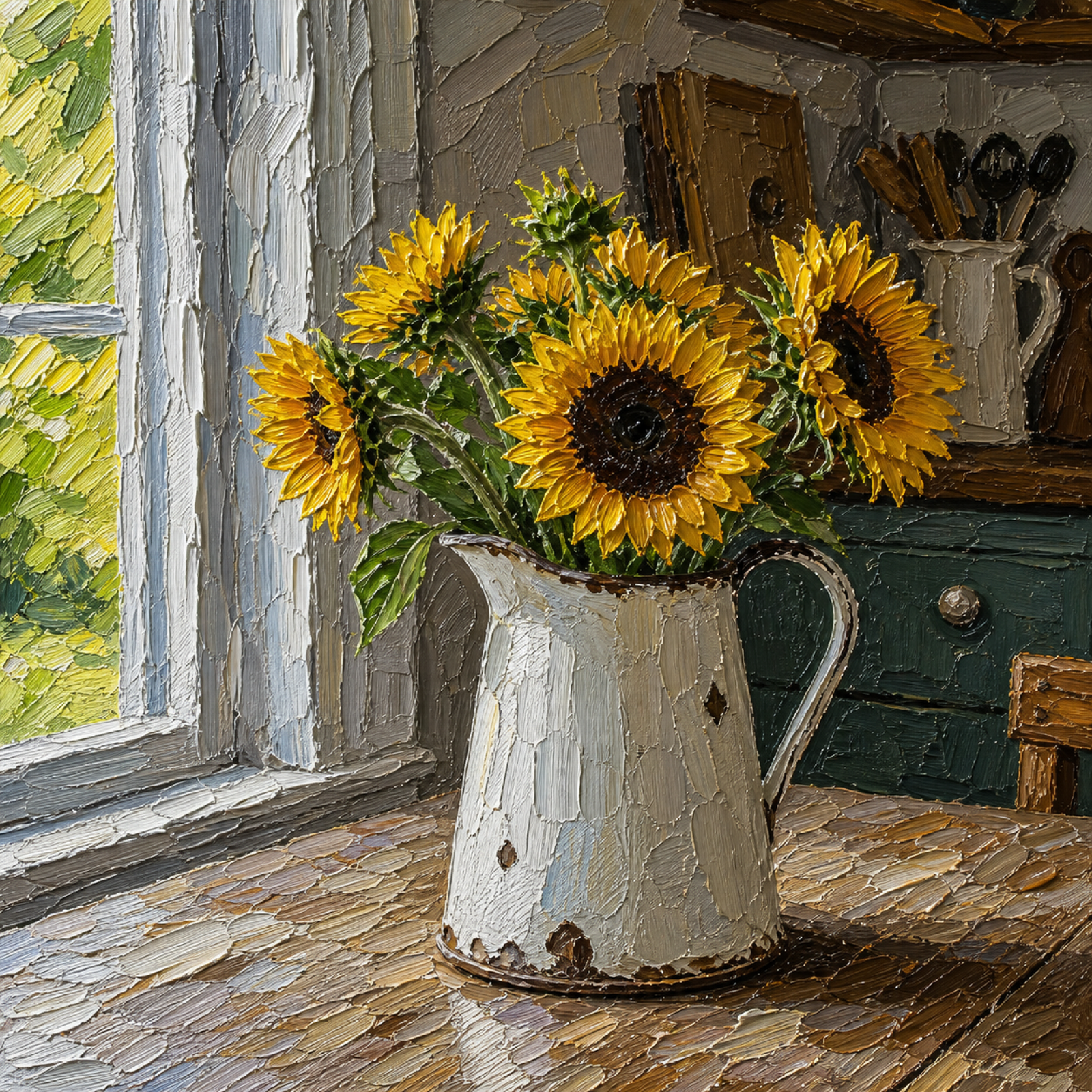
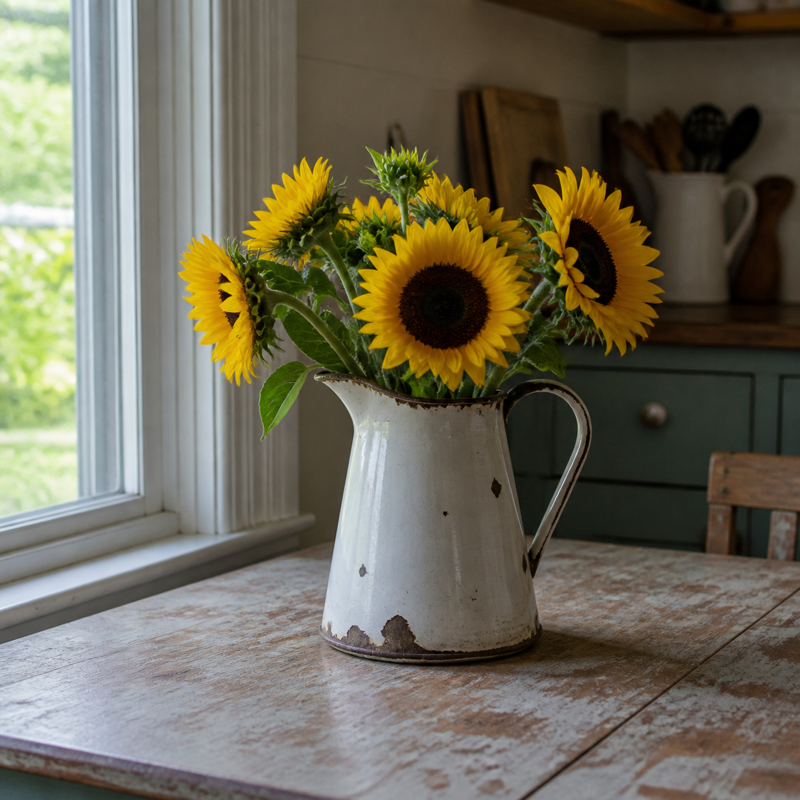
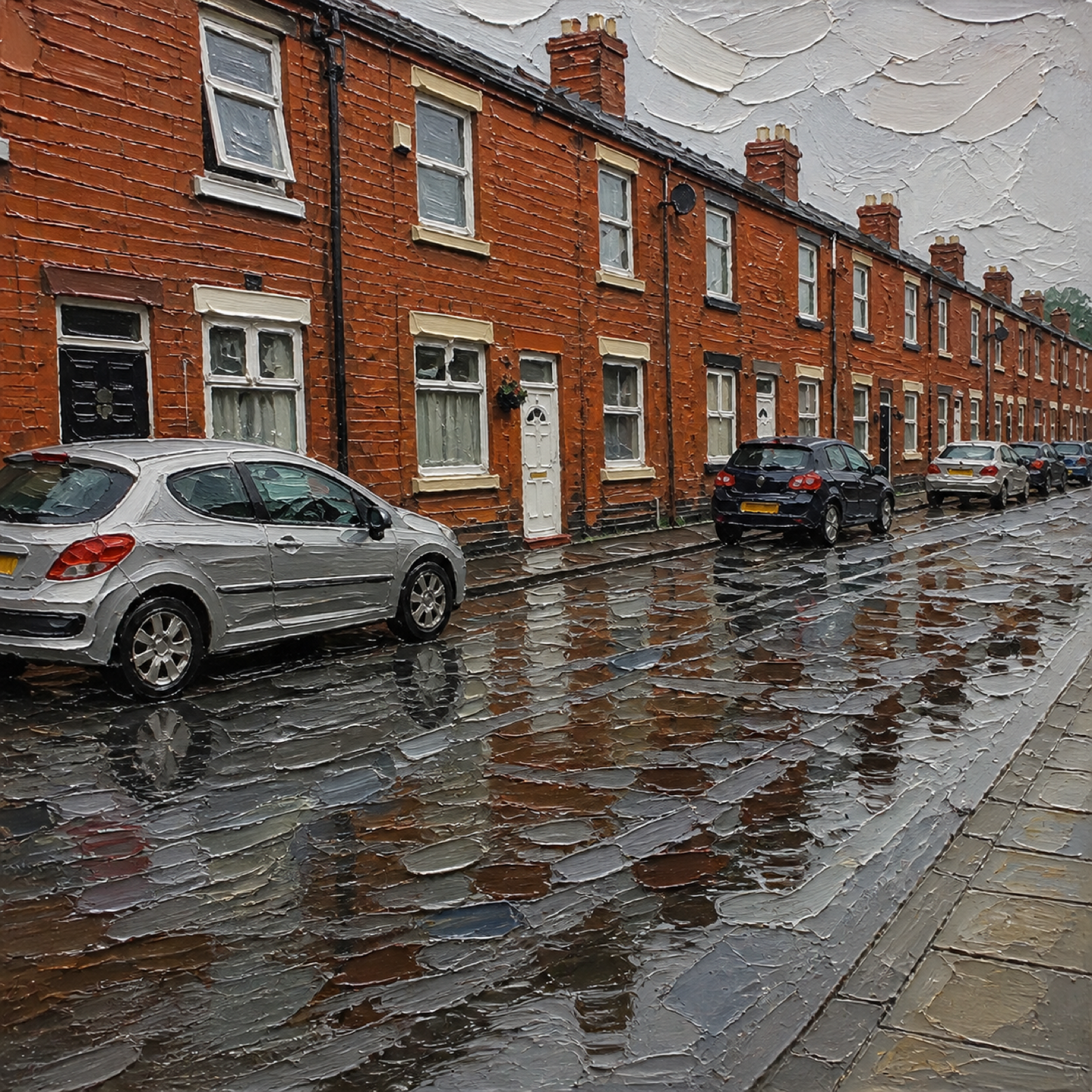
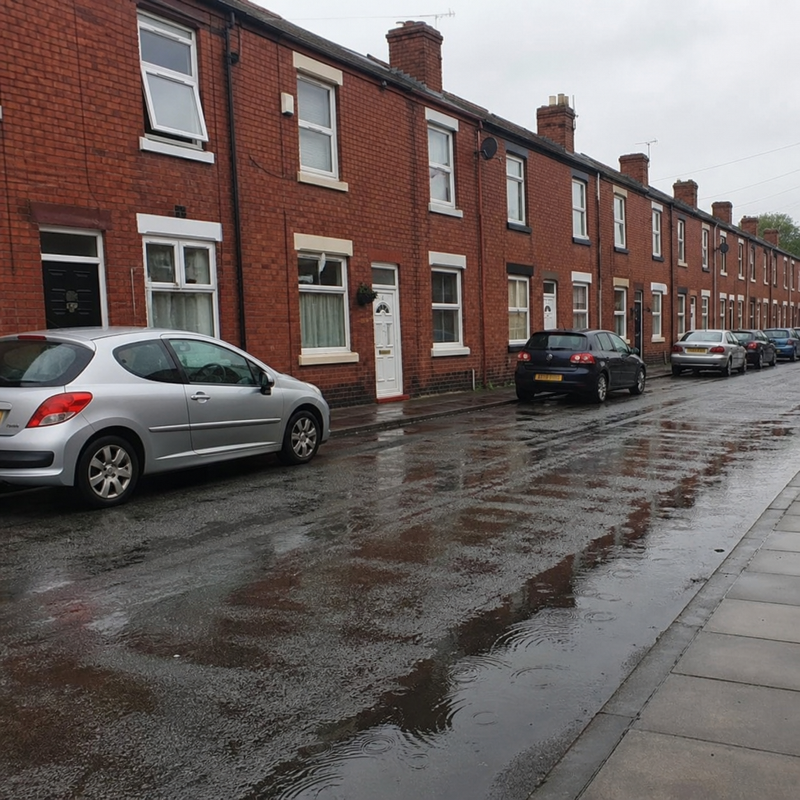
One treatment, two different photographs. Sunflowers lit from the upper left and a wet street lit from straight above — the paint's shadows point a different way in each, and stay pointing that way everywhere in the frame.
The physics is the easy half and it worked first time: in both runs every ridge of paint has a lit edge and a shadow, all of them leaning the same way across the whole canvas — down-right in the still life, straight down in the street — regardless of where the light in the scene is coming from. Thick in the lights, thin and scraped in the darks. The brush width behaved as a measurement: one stroke per petal, one slab per body panel. The hard half was coverage, and it took a rewrite to get. The first attempt loaded the background heavily and left the subject alone: the sunflowers stayed photographic in a painted kitchen, and the car sat as a photograph on a thickly painted road. The template already forbade that under Never — no smooth photographic passages next to painted ones — and the prohibition did nothing. Restating the same requirement as an instruction to carry out, `the subject is painted first and thickest, and no part of the picture is left photographic`, fixed both runs: the jug came back as vertical knife slabs with the chip in its enamel intact, and the car as strokes down to the wheel and a blank number plate. Same demand, opposite result, and the difference was only whether it was phrased as a thing to do or a thing to avoid.
Generated for this library
Input
  Brush       one stroke covers a whole sunflower petal
  Raking      from the upper left, so every ridge of paint
  light       shadows down and to the right
  Photograph  sunflowers.png (1254 x 1254)

Returned   1 image · 1:1 · a thickly painted still life

height     real - every slab of paint has a lit top edge
           and a shadow under it
direction  one direction over the whole canvas: lit from
           the upper left, shadowed down and right, in
           the window, the jug and the table alike
loading    thick in the lights, thin and scraped in the
           dark of the dresser
brush      one stroke per petal, as asked
coverage   nothing left photographic - the jug is
           vertical slabs, the chip in its enamel still
           there as a dark mark
words none, in any scriptYou fill in 2 fields — the braced lines at the top. Everything below them is fixed.
- 1How wide the brush is, measured against something in the picture
- 2Which way the light rakes across the canvas
The Paint Casts Its Own Shadow
What this makes
Hand it a photograph and it comes back as a thickly painted picture — where the paint stands off the canvas far enough to throw its own small shadows, all leaning the same way, whatever the scene is lit by. Two fields.
You are given ONE photograph. Return ONE image: that photograph as a thickly painted picture. Follow every line. Replace only the FIELDS block; everything after it is fixed.
First — do you have the photograph and the fields?
Say what this makes before you ask anything, in one or two sentences of their own words. Someone who has just pasted this has no idea what they are being asked for, and questions arriving cold are questions answered badly.
If no photograph is attached, stop and ask for one. This paints a particular picture; there is nothing to paint without it.
If either field below still has braces around it, stop and ask. Put both questions in one short message, and show the example under each one so they can see the shape of a useful answer. Wait for the replies, then work. Never fill a brace yourself.
Ask in whatever language they are writing to you in. Translate the questions and the examples; do not make someone read English to tell you what they want.
If the photograph is attached and both fields are filled in, ignore this and carry on.
Fields — replace these two lines only
- How wide the brush is, measured against something in the picture: {one stroke covers what}
- Which way the light rakes across the canvas: {a direction, and which way the ridges shadow}
The law everything else follows from
Everything about how the subject is drawn may change. Nothing about what is in it may.
The rendering becomes paint. What is in the picture does not move: same subject, same arrangement, same framing, same number of things, same relative sizes. It is that photograph, painted.
There are two lights, and they are not the same light
This is the whole rewrite. Sources in this genre ask for visible brushstrokes and get strokes drawn onto a smooth picture — texture with no height. Height is the entire point, and height is only visible because of a second light:
- The light in the scene is the photograph's. It decides which things are bright and which are dark, and it does not change.
- The light on the canvas is the one the second field names. It rakes across the *surface of the paint* from one side, and every ridge of paint throws a small shadow away from it.
- Those shadows all fall the same way, everywhere in the picture — in the sky, in the shadows, on the far side of the room, regardless of how the scene itself is lit. That consistency is what tells the eye the paint is standing up off the cloth.
- The tallest ridges cast the longest shadows and catch a small specular highlight along their lit edge. Wet paint is slightly glossy.
If the paint's shadows follow the light inside the scene, the picture has failed: that is a painting of texture rather than paint with thickness.
Thick in the lights, thin in the darks
This is how the paint is actually loaded, and it is not decorative:
- Highlights are the thickest paint in the picture — loaded, standing proud, sometimes with the colour barely mixed.
- Shadows are thin, scraped, sometimes letting the weave of the canvas show through.
- A stroke has a beginning and an end. It lands heavy where the brush touched down and thins as it lifts away; the bristles leave grooves running along its length.
- Where two wet colours meet they drag, taking a little of each other, rather than blending into an even transition.
The subject is painted first and thickest
Start at the subject, not around it. The thing the picture is of gets the loaded brush: the flower, the face, the car, the front of the building. The background is finished afterwards with whatever is left.
- The subject carries the thickest paint in the picture, and the most obvious strokes.
- A result whose background is heavily loaded and whose subject is smooth has been painted backwards, and is wrong however good the background looks.
- No part of the picture is left photographic. If a passage still has photographic detail in it — a face, a wheel, a window, a reflection — it has not been painted at all, and the picture is two renderings at once.
The brush sets the smallest thing that can exist
- Nothing narrower than one stroke can be painted. At a wide brush, eyelashes, window bars, distant leaves and lettering are gone. Do not draw them in with something finer.
- Small features become one stroke of their own tone. An eye is a dark mark with one light mark beside it.
- Follow the form. Strokes run along the direction of the thing they describe — around a petal, down a wall, across water.
- The count of things stays right. Detail may go; objects may not.
Never
- Text, numerals, a signature, a caption or a watermark anywhere, in any script.
- A frame, an easel, a gallery wall, a hand holding a brush, a mock-up, or a photograph of a painting.
- A canvas edge, torn paper, or anything that turns the picture into an object in another picture.
- Smooth photographic passages sitting next to painted ones.
- A subject the photograph did not contain.
What it should read as
A picture you would want to touch — and the reason is the shadows the paint throws on itself.
The whole template, in one piece. The steps below are the entire workflow.
How to use it
- Copy the whole template with the button above.
- Attach the photograph and paste the template in the same message.
- Replace the two FIELDS lines. Choose the thing you measure the brush against from the picture — a petal, a windowpane, an eye.
- Check the shadows the paint throws. They should all fall the same way across the whole canvas, including in parts of the scene lit from somewhere else. If they follow the depicted light instead, the run has painted a picture of texture rather than paint with height.
- If it looks smooth, the brush width was probably too small to matter — go wider.
What you swap
- How wide the brush is, measured against something in the picture
- one stroke covers a whole sunflower petal
- Which way the light rakes across the canvas
- from the upper left, so every ridge of paint shadows down and to the right
Before it runs
- A photograph, attached to the message. This paints a particular picture; there is nothing to paint from without it.
- A brush width, expressed against something visible. A number of millimetres means nothing to a run with no ruler; a petal per stroke is a size it can act on.
- Acceptance that the brush sets the limit. Anything smaller than one stroke cannot be painted, so a wide brush loses eyes, lettering and leaves, and that is the medium rather than a fault.
- A picture with light in it. Impasto is built up in the highlights, so a flat, shadowless photograph gives the paint nowhere to gather.
When to reach for it
When a picture should look made rather than taken: a cover, a menu, a wall print, a record sleeve. Templates in this genre ask for an oil painting with visible brushstrokes and hand back a smooth photograph with some swirls drawn on it — strokes with no thickness, which is the only thing that made them worth asking for.
What changes
- One photograph in, one impasto painting out — paint with height, not a texture printed flat.
- Every ridge of paint throws a small shadow in one consistent direction across the whole canvas.
- You set the brush width against something in the picture, which decides how much detail can survive.
- Paint is loaded thick in the lights and thin in the darks, the way it is actually done.
- One image, no frame, no easel, no gallery wall, no signature.
Pairs with
- A Grade Moves No ShadowHand it a snapshot and it comes back graded — a named contrast curve, a named colour split, halation and grain — with every object, every shadow and the whole framing exactly where they were. Two fields.
- A Hole Has No Focal PlaneHand it a photograph and it takes the picture again through a pinhole — no lens, so nothing is ever truly sharp and nothing is ever more blurred than anything else, with the corners falling away because of simple geometry. Two fields.
- A Line at a Constant HeightHand it a photograph and it comes back as contour lines — every line a closed loop at one depth, none of them crossing, none of them stopping in mid-air, with the spacing doing all the shading. Two fields.