

The Damage, Not the Colour
Hand it a damaged old photograph and it mends what the print suffered — scratches, tears, staining, fading — and refuses to invent a single colour nobody alive can confirm. Two fields.
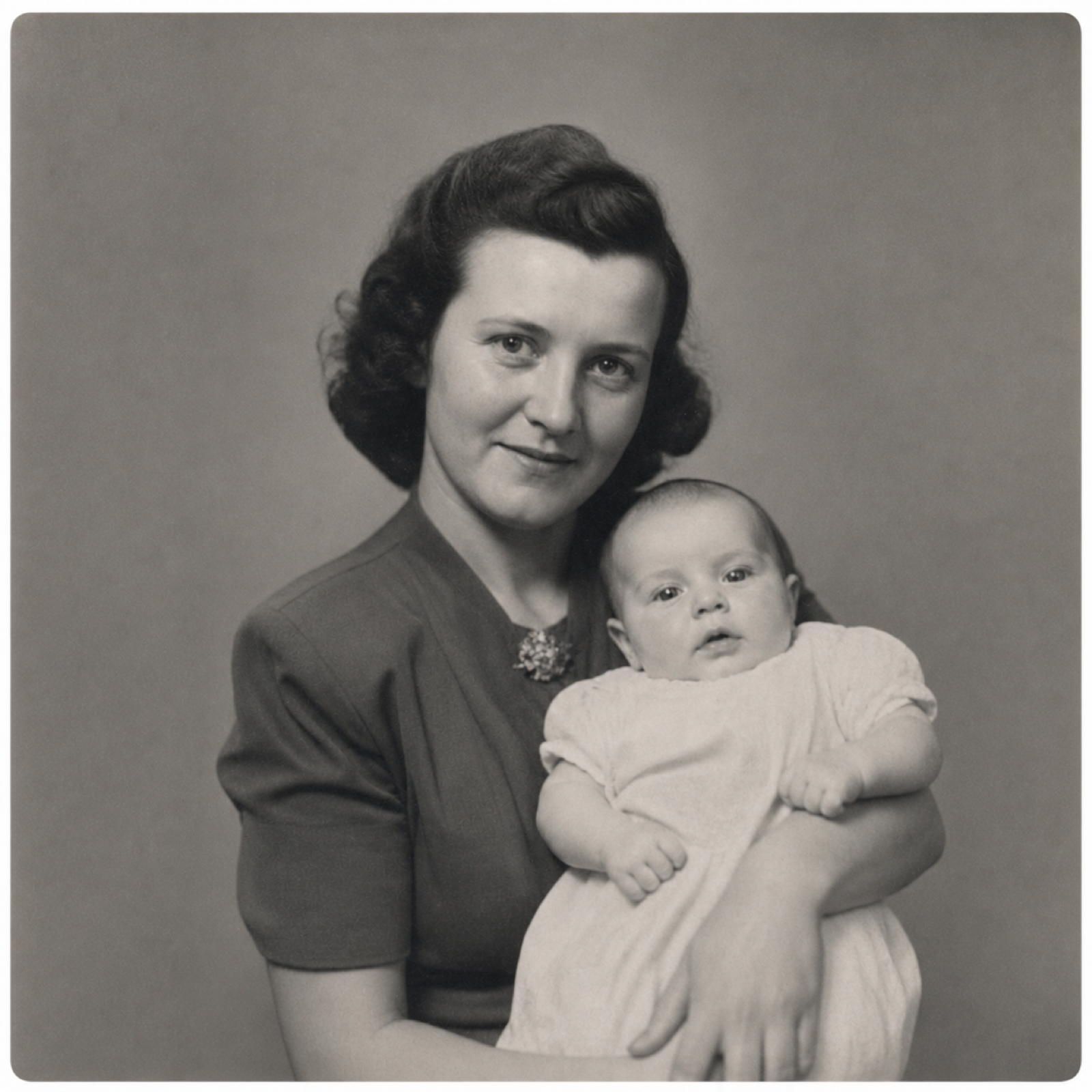
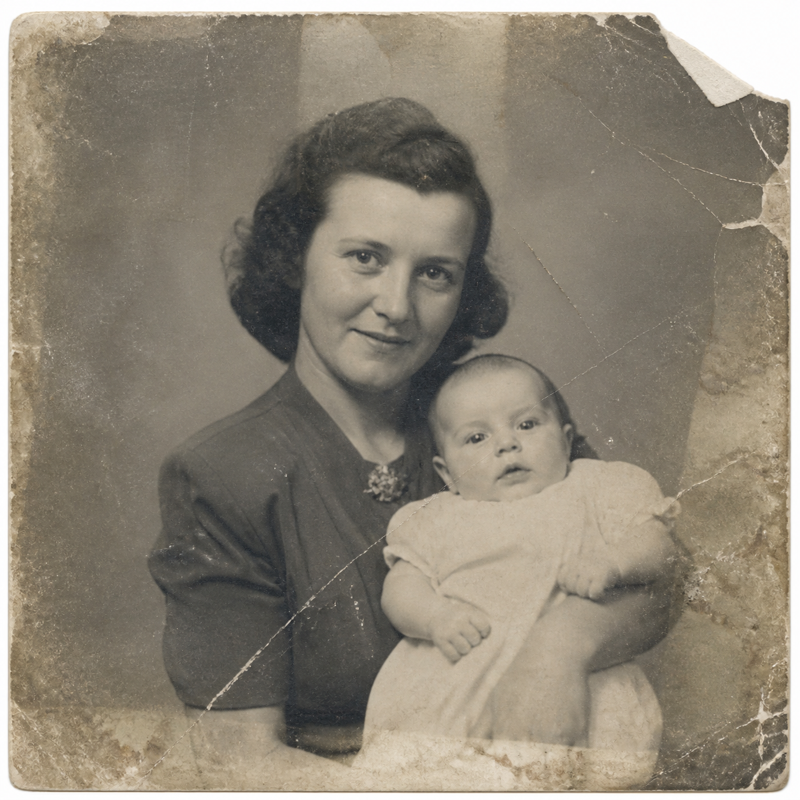
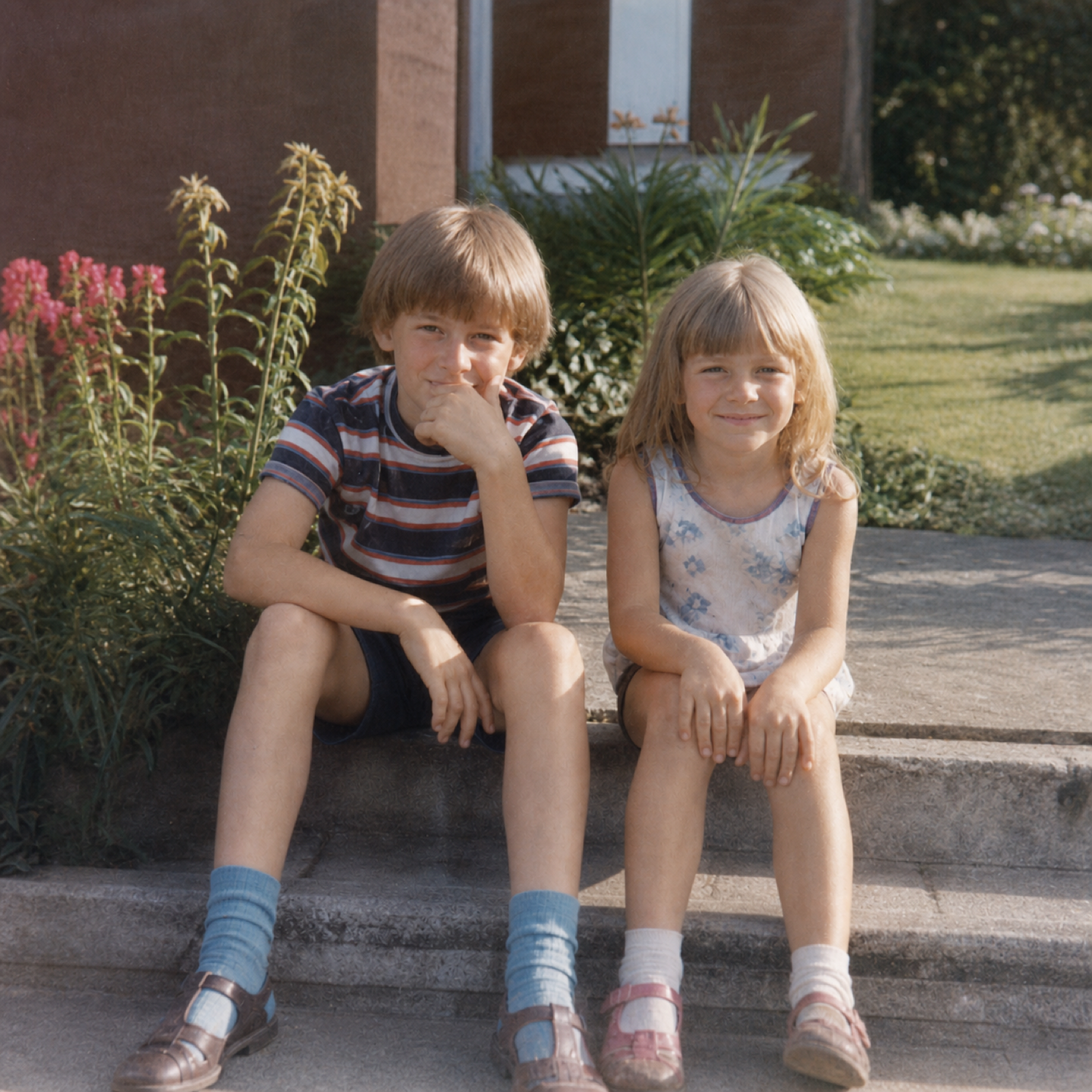
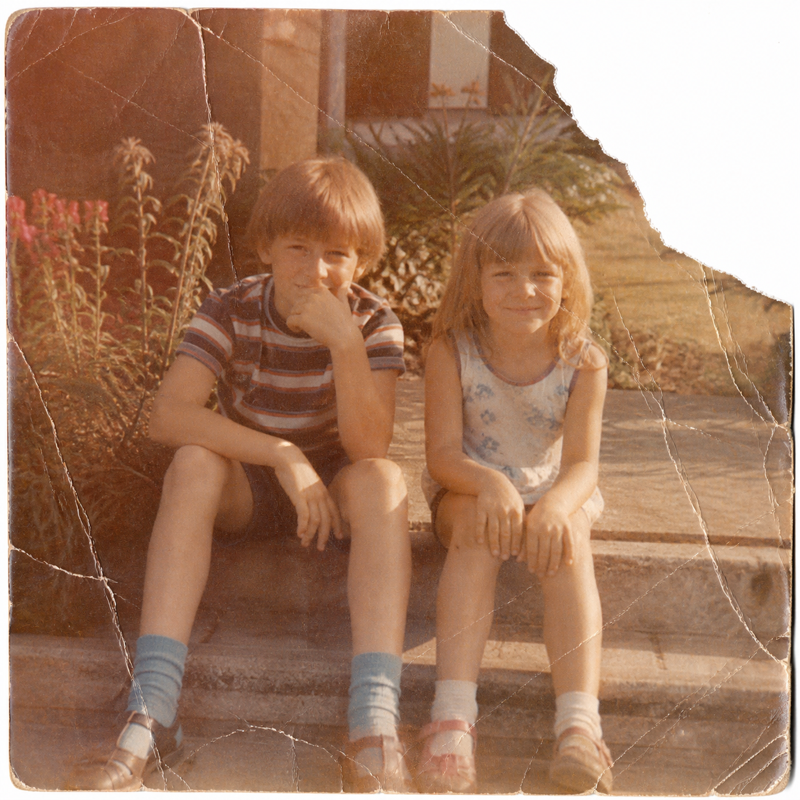
One treatment, two different photographs. A monochrome studio print and a colour snapshot gone orange — the two ends of what the colour field is for, one asking for nothing at all and one asking for only what the dyes still hold.
Both runs mend the damage and both keep the people. Cracks, tears, staining, creases and a missing edge are gone, the crops and poses are untouched, and the faces come back recognisably the same — which is the thing that matters here and the thing a restoration most often quietly loses. The colour rule split down the middle. The grey print stayed grey: no hair colour, no dress colour, nothing asserted about anybody, which is the default doing exactly its job. The colour print did not. Told to recover only what the dyes still hold and add nothing, it returned a confident green lawn, pink flowers and blue socks — a fully colourised picture rather than a recovered one, and nobody can now say which of those colours was ever there. Read that as the template's real limit: it can stop colour being invented on a monochrome print, and it cannot stop a faded colour print being finished off. Check any recovered colour against somebody's memory before you keep it. Second and smaller: the template says grain is not damage and must stay, and both runs came back smooth and modern, with the studio backdrop's mottling evened away on the first. A print that reads as never having been handled no longer reads as old.
Generated for this library
Input
  Of and damage  a woman holding a baby, studio portrait -
                 a crack across her shoulder, a torn
                 corner, brown staining, heavy fading
  Colour         leave it grey
  Photograph     print-scan.png (1254 x 1254)

Returned   1 image · 1:1 · mended, still grey

mended     crack, tear, staining and fade gone; the
           torn corner rebuilt from the border it
           continues
held       crop, pose, expression, the dress, the
           studio backdrop, the grain
colour     none added - the print's own tones only
faces      rebuilt only where the damage crossed them,
           and only as far as the other side of the
           face vouches for
words      none added; nothing written on the print
was alteredYou fill in 2 fields — the braced lines at the top. Everything below them is fixed.
- 1What it is of, and what the damage is
- 2Colour
The Damage, Not the Colour
What this makes
Hand it a damaged old photograph and it mends what the print suffered — scratches, tears, staining, fading — and refuses to invent a single colour nobody alive can confirm. Two fields.
You are given ONE damaged photograph. Return ONE image: the same photograph with the damage mended and nothing else altered. Follow every line. Replace only the FIELDS block; everything after it is fixed.
First — do you have the photograph and the fields?
Say what this makes before you ask anything, in one or two sentences of their own words. Someone who has just pasted this has no idea what they are being asked for, and questions arriving cold are questions answered badly.
If no photograph is attached, stop and ask for one. There is nothing to mend without it, and a picture generated from the description instead is a different family in the same pose.
If either field below still has braces around it, stop and ask. Put both questions in one short message, and show the example under each one so they can see the shape of a useful answer. Wait for the replies, then work. Never fill a brace yourself.
Ask in whatever language they are writing to you in. Translate the questions and the examples; do not make someone read English to tell you what they want.
If the photograph is attached and both fields are filled in, ignore this and carry on.
Fields — replace these two lines only
- What it is of, and what the damage is: {who or what is in it, and the damage you can see}
- Colour: {the words leave it grey, or the colours somebody actually remembers}
The law everything else follows from
Change what is broken. Everything else is not yours to improve.
The temptation in a repair is to make the picture better, and better is the enemy here: warmer light, a tighter crop, a cleaner background, a richer colour. Every one of those makes the result unusable, because the reader is putting this back beside pictures that were not improved. A repair that cannot be set next to the original as the same picture is a new picture.
What counts as broken is named in the fields and nowhere else. It is never inferred from the picture, and it never grows during the work.
What damage is, and what it is not
Damage is what happened to the print after the shutter closed. Scratches, cracks, tears, creases, missing corners, foxing, mould, water staining, silver mirroring, dust, chemical fading, and the orange shift of a colour print that sat in the light.
These are not damage. They are the photograph:
- Softness, grain, motion blur, a shallow or missing focus.
- The framing, however awkward, and whatever is cluttering the background.
- Expressions. A half-closed eye, a stiff pose, a child mid-blink.
- The clothes, the haircuts, the furniture and the colour palette of the decade it was taken in.
Repairing any of those is not restoration. It is replacement, and the person who kept this print for fifty years will see it immediately.
Faces
A face is rebuilt only as far as the surviving evidence reaches.
- Where damage crosses a face, continue what is there: the line of a cheek that runs on either side of a crack, an eye whose partner is intact.
- Where nothing survives — a hole through an eye, a face gone under a stain — leave that area soft and unresolved rather than inventing a feature.
- Never adjust a face that is not damaged. No symmetry, no reshaping, no smoothing, no whitening, no opening of closed eyes.
A restored face that is not theirs is worse than a damaged one that is. The soft patch is honest and can be lived with; the invented eye cannot.
Colour
Default: none. A grey photograph comes back grey. A faded colour photograph comes back with its own colours recovered toward what the dyes still hold — not toward what the scene probably looked like.
Colour is added only where the second field names it, and only there. If it says her dress was pale blue, the dress is pale blue and nothing else changes. Everything the field does not name keeps the tone the print gives it.
Never assert a colour that cannot be known: hair, eyes, skin undertone, a uniform, flowers, a car, a wall. These are claims about somebody's family, and a plausible one is still invented. Skin stays at the value the print records; it is not warmed toward a preferred tone.
The repair
- Work at the damage, not across the picture. A pass that sharpens or denoises the whole frame is not a repair.
- Grain is not damage. The grain of the film stays, and the repaired areas carry the same grain as their surroundings.
- Keep the print's own edges: the border, a deckled edge, a rounded corner, a studio's blind stamp.
- A missing edge or corner is rebuilt only from what continues into it — a border, a flat backdrop, a curtain. Where a missing piece held part of the scene, leave it missing or crop it away. Do not invent what was in it.
- Even out fading and staining to the tone of the surrounding print, not to a clean modern white.
Never
- Add, remove or move a person, an animal or an object.
- Change an expression, a pose, a gaze, or the way somebody is standing.
- Modernise: no smoothed skin, no whitened teeth, no reshaped bodies, no replaced clothing, no new background.
- Crop, straighten, rotate or extend the frame.
- Add lettering, a date, a caption, a watermark or a border, in any script. Writing already on the print stays exactly as it is, character for character, including where it is damaged.
What it should read as
The same print, on the day it was taken out of the envelope — before fifty years of handling, and no further forward than that.
The whole template, in one piece. The steps below are the entire workflow.
How to use it
- Copy the whole template with the button above.
- Attach the scan and paste the template in the same message.
- Replace the two FIELDS lines. Name the damage you can see; anything you do not name is treated as part of the photograph.
- Leave the second field as 'leave it grey' unless someone can tell you a colour from memory. Colour is the part of a restoration that cannot be checked later.
- Compare faces first. If a face came back looking like somebody else, that is the failure this template exists to catch, and no amount of clean background makes up for it.
What you swap
- What it is of, and what the damage is
- a woman holding a baby, studio portrait — a crack across her shoulder, a torn corner, brown staining and heavy fading
- Colour
- leave it grey
Before it runs
- The photograph itself, attached to the message, scanned as well as you can manage. Everything this does is bounded by what survived, so a phone snapshot of a print at an angle takes damage in with it.
- Someone who remembers, if you want colour. The second field is for what a person can actually confirm — her dress was pale blue — and for nothing else. If nobody remembers, the honest answer is to leave it grey, and it is the default for that reason.
- A tolerance for what cannot be recovered. Where a face is gone, this leaves it soft rather than inventing a feature, and that is the right outcome even though it is not the impressive one.
- The damage named. 'Make it look better' has no edge to work at, and a run with no edge improves the whole picture instead — which is how a restoration comes back sharper, warmer and no longer the same photograph.
When to reach for it
When a family print needs to survive being scanned: cracks through a face, a torn corner, mould, a colour snapshot gone orange. Templates in this genre restore beautifully and colourise while they are at it, asserting a hair colour and a dress colour that nobody asked for and nobody can check.
What changes
- One damaged photograph in, one mended photograph out — same crop, same pose, same era.
- Damage is defined as what happened to the print after the shutter, so soft focus, grain and an awkward expression are left alone as part of the picture.
- Colour is off by default: a grey photograph comes back grey unless the field names a colour somebody actually remembers.
- A face with damage across it is rebuilt only as far as the surviving evidence reaches, and left soft where nothing survives.
- No modernising — no smoothed skin, no straightened posture, no opened eyes, nobody added or removed.
Pairs with
- A Grade Moves No ShadowHand it a snapshot and it comes back graded — a named contrast curve, a named colour split, halation and grain — with every object, every shadow and the whole framing exactly where they were. Two fields.
- A Hole Has No Focal PlaneHand it a photograph and it takes the picture again through a pinhole — no lens, so nothing is ever truly sharp and nothing is ever more blurred than anything else, with the corners falling away because of simple geometry. Two fields.
- A Line at a Constant HeightHand it a photograph and it comes back as contour lines — every line a closed loop at one depth, none of them crossing, none of them stopping in mid-air, with the spacing doing all the shading. Two fields.