
Pressure Pushes Every Panel Out
Hand it a photograph and it comes back inflated — the same thing sewn from panels and blown up, so every surface bulges and every seam pulls in, because that is the only shape air makes. Two fields.
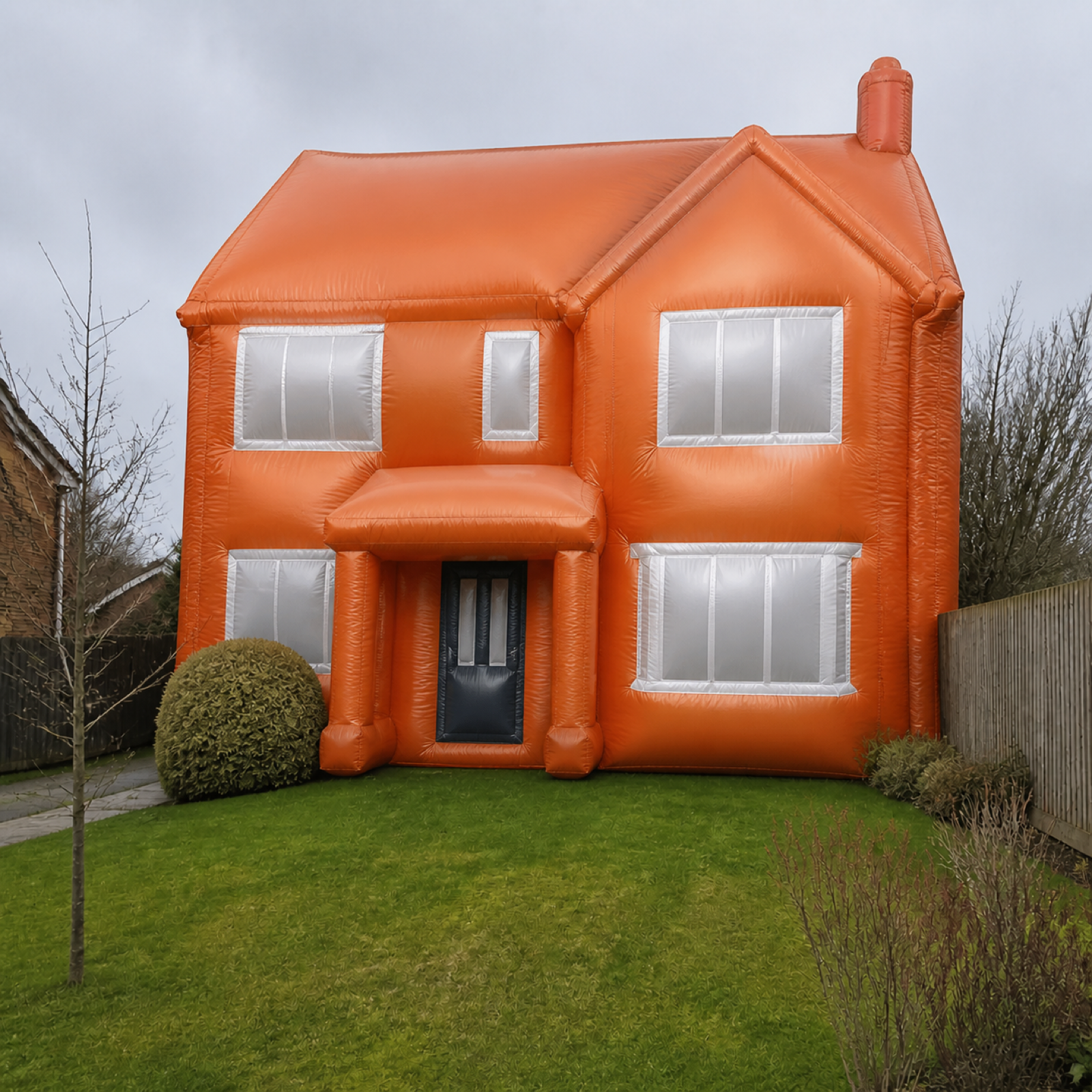
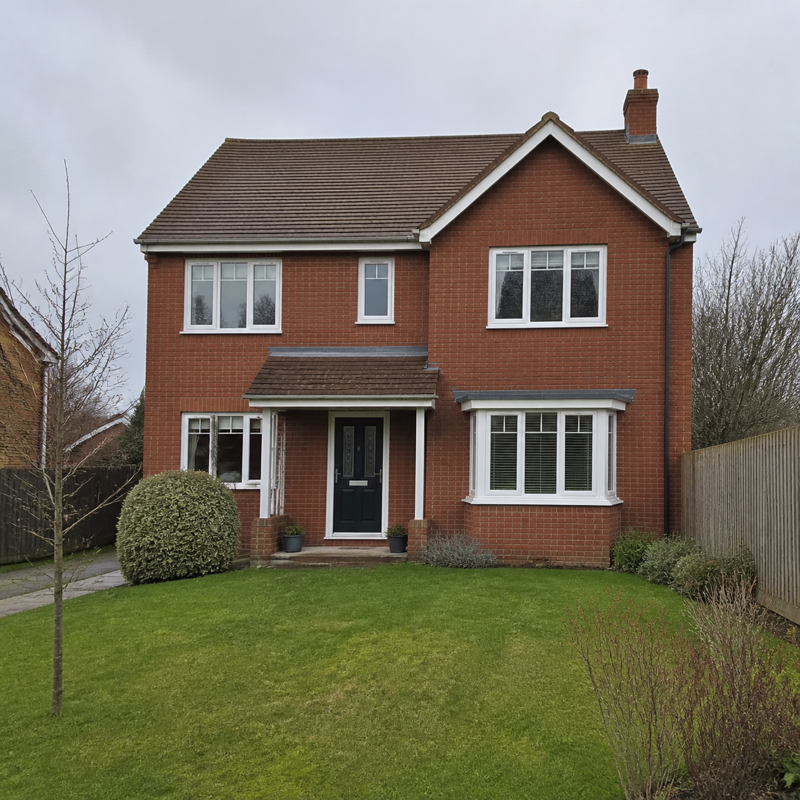
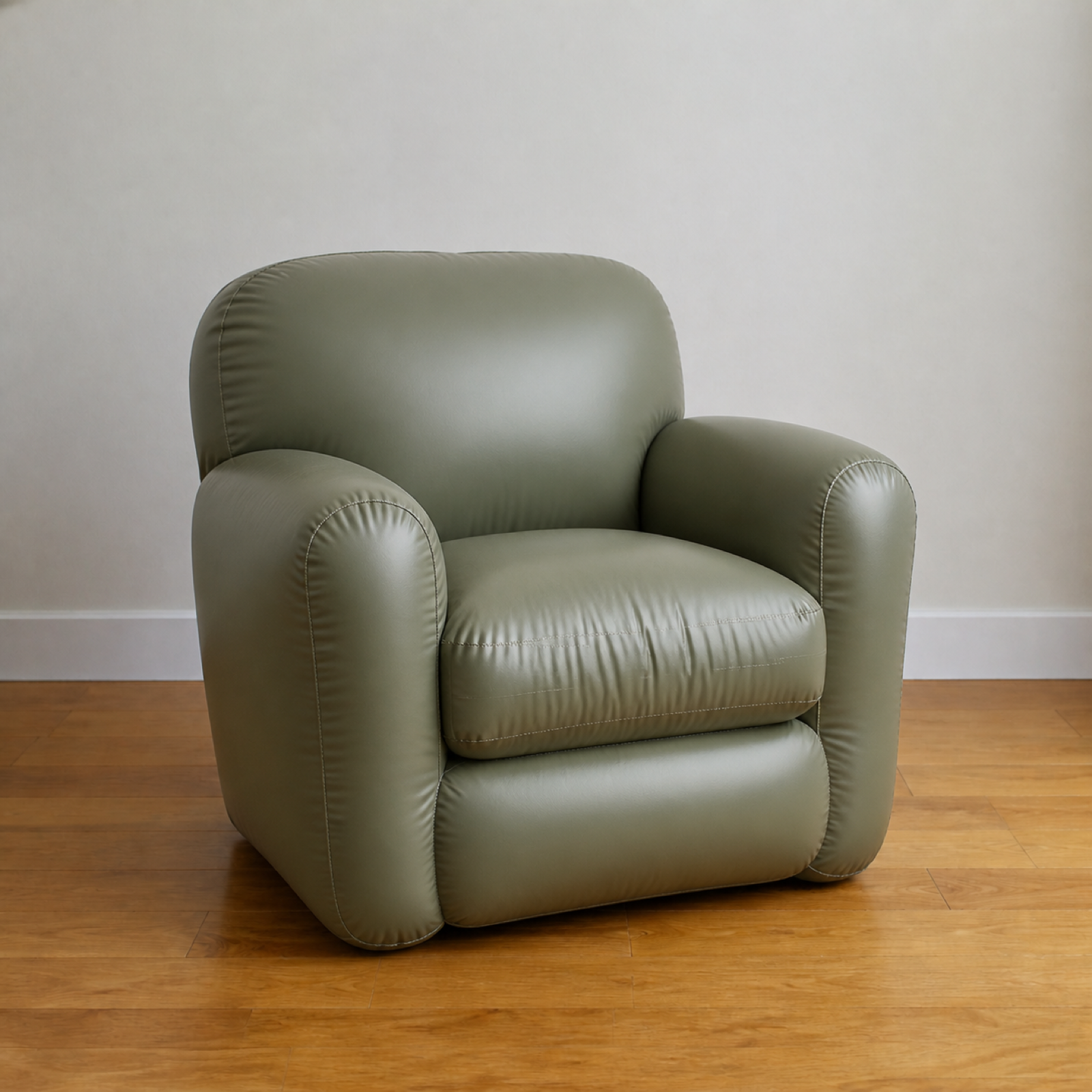
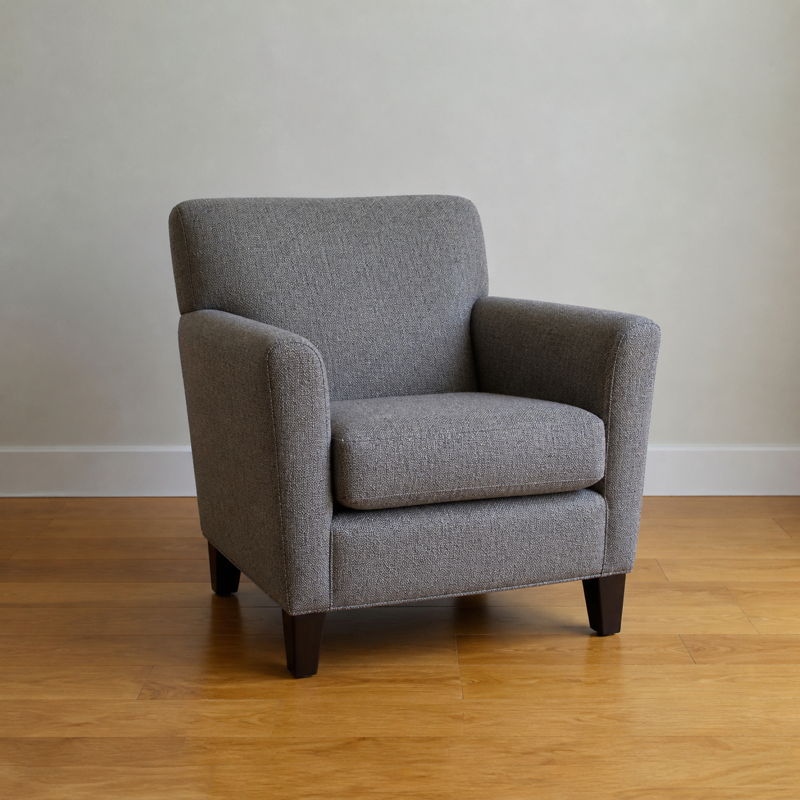
One treatment, two different photographs. A house and an armchair — one full of corners that have to become seams, one already soft enough to test whether the pressure setting does anything at all.
Both runs do what the template asks, and the second proves the first field is doing work. There is not a sharp edge anywhere in either: every wall, roof slope and cushion is a dome, every corner is two bulges meeting at a seam pulled inward, and the seams are the only lines on the object. Detail below the size of a panel went as promised — the house's windows are flat silver panels with no frames, the chair's legs are simply absent — while the garden, fence, floor and wall behind are untouched. The pressure field bound cleanly on the chair: its back is tight and smooth with a hard highlight and its seat cushion is visibly slacker, wrinkling in soft folds between its seams, exactly as the field described. That is a rare thing in this set, a setting with no number in it that the run actually acted on, and it works because naming a slack part asks for more wrinkles rather than fewer.
Generated for this library
Input
  Pressure    hard enough that the roof is tight and
              drum-like, but the porch is still slightly
              slack
  Material    matt orange ripstop nylon, one panel per
              wall and one per roof slope, seams along
              every corner
  Photograph  house.png (1254 x 1254)

Returned   1 image · 1:1 · the house, inflated

bulges     every wall and roof slope is a dome, the
           chimney a fat tube
seams      pulled inward along every corner, and they
           are the only lines on the object
pressure   the field bound - the chair's back is tight
           and drum-like, its seat cushion wrinkles
detail     windows became flat silver panels, and the
           chair's legs disappeared
place      garden, fence, floor and wall untouched
words none, in any scriptYou fill in 2 fields — the braced lines at the top. Everything below them is fixed.
- 1How hard it is blown up, said against a part of the object
- 2The material and how the panels are laid out
Pressure Pushes Every Panel Out
What this makes
Hand it a photograph and it comes back inflated — the same thing sewn from panels and blown up, so every surface bulges and every seam pulls in, because that is the only shape air makes. Two fields.
You are given ONE photograph of ONE thing. Return ONE image: that thing sewn from fabric panels and inflated. Follow every line. Replace only the FIELDS block; everything after it is fixed.
First — do you have the photograph and the fields?
Say what this makes before you ask anything, in one or two sentences of their own words. Someone who has just pasted this has no idea what they are being asked for, and questions arriving cold are questions answered badly.
If no photograph is attached, stop and ask for one. This inflates a particular object; there is nothing to blow up without it.
If either field below still has braces around it, stop and ask. Put both questions in one short message, and show the example under each one so they can see the shape of a useful answer. Wait for the replies, then work. Never fill a brace yourself.
Ask in whatever language they are writing to you in. Translate the questions and the examples; do not make someone read English to tell you what they want.
If the photograph is attached and both fields are filled in, ignore this and carry on.
Fields — replace these two lines only
- How hard it is blown up, said against a part of the object: {a part, and how tight it is}
- The material and how the panels are laid out: {a fabric, and where the seams run}
The law everything else follows from
Everything about how the subject is drawn may change. Nothing about what is in it may.
The rendering becomes fabric and air. What is in the picture does not move: same subject, same angle, same parts, same number of things, same arrangement, same rough proportions. It is that photograph, blown up.
Air pushes outward, everywhere, equally
This is the whole rewrite, and it is one sentence of physics.
The air inside pushes on every square inch of the skin with the same force. The skin can only resist where it is held — at a seam. So:
- Every panel bulges outward, into a smooth dome, fullest at its middle and flattening as it approaches its edges.
- Every seam pulls inward, into a crease, because that is where the fabric is anchored. The seams are the only lines on the whole object.
- There are no sharp edges anywhere. What was a corner is now two bulges meeting at a pulled-in seam.
- A big panel bulges more than a small one, because there is more unsupported skin. That is why a maker uses more seams where they want the shape to stay tight.
- Flat is impossible. No part of an inflated object is flat unless something is pressing on it.
What the pressure does
- A tight part is smooth and drum-like, with a hard specular highlight and no wrinkles at all.
- A slack part wrinkles, in soft folds running between its seams.
- The part the first field names sets the level and everything else is judged against it.
- Where the object rests on the ground it flattens and bulges out at the sides, and the ground takes a soft wide shadow.
The fabric behaves like fabric
- Small creases radiate from every seam, a few centimetres long, where the stitching gathers the material.
- The fabric stretches thinnest over the fullest part of a bulge, so the colour is slightly lighter there.
- It takes light like cloth — a broad soft highlight if matt, a tight one if coated — and never like glass, chrome or jelly.
- The weave shows at close range, and the seams are stitched, with a visible line of thread.
What cannot survive
- Nothing smaller than a panel exists. Windows, handles, trim, lettering, spokes, buttons and hinges are gone, or become a seam, or become a differently coloured panel.
- Colour changes happen at seams, because a different colour means a different piece of fabric.
- Thin parts become tubes: a leg, a branch, an arm, a chair rail — each is a sewn sausage, and it sags a little under its own weight.
- The count of things stays right. Detail may go; objects may not.
Never
- Text, numerals, a logo, a caption or a watermark anywhere, in any script.
- A smooth seamless render, glossy plastic, chrome, jelly or a balloon-animal twist.
- Sharp edges, flat panels, or a corner without a seam.
- A shop, a hand, a pump, a person, a frame, a border or a mock-up.
- A subject the photograph did not contain.
What it should read as
Something a company actually made and shipped folded in a bag — and you can see every seam that made it hold its shape.
The whole template, in one piece. The steps below are the entire workflow.
How to use it
- Copy the whole template with the button above.
- Attach the photograph and paste the template in the same message.
- Replace the two FIELDS lines. Lay the panels out along the object's real edges — that is where a maker would put them.
- Look at a corner. It should be a pulled-in seam between two bulges, never a sharp edge.
- Check the pressure reads. A slack part should wrinkle and a tight part should be smooth and drum-like; if everything looks the same, the run made a solid model.
What you swap
- How hard it is blown up, said against a part of the object
- hard enough that the roof is tight and drum-like, but the porch is still slightly slack
- The material and how the panels are laid out
- matt orange ripstop nylon, one panel per wall and one per roof slope, seams along every corner
Before it runs
- A photograph, attached to the message, of a thing rather than a scene. This inflates one object, and a street does not inflate.
- A subject with a shape worth rounding. Something already soft and round barely changes; something angular becomes funny.
- A panel layout you have thought about. The seams are the drawing, and 'some seams' will get you a smooth blob with a few lines on it.
- Acceptance that detail goes. Anything smaller than a panel cannot exist, so lettering, handles, windows and trim all disappear or become a seam.
When to reach for it
When something should look soft, large and faintly absurd: a title card, a cover, a shop display, a poster, a toy. Templates in this genre ask for an inflatable or balloon version and hand back a smooth glossy 3D model — a rounded shape with no seams, which is a shape air has never made.
What changes
- One photograph in, one inflated object out — sewn from panels and blown up.
- Every panel bulges outward and every seam pulls inward, which is the only thing pressure can do.
- Detail below the size of a panel disappears, because a seam is the smallest mark available.
- The material behaves like fabric: it creases near seams, it stretches thin over the fullest curves, and it wrinkles where it is slack.
- One image, no type, no border, no shop, no hands.
Pairs with
- A Grade Moves No ShadowHand it a snapshot and it comes back graded — a named contrast curve, a named colour split, halation and grain — with every object, every shadow and the whole framing exactly where they were. Two fields.
- A Hole Has No Focal PlaneHand it a photograph and it takes the picture again through a pinhole — no lens, so nothing is ever truly sharp and nothing is ever more blurred than anything else, with the corners falling away because of simple geometry. Two fields.
- A Line at a Constant HeightHand it a photograph and it comes back as contour lines — every line a closed loop at one depth, none of them crossing, none of them stopping in mid-air, with the spacing doing all the shading. Two fields.