
Drawn On, Not Drawn In
Hand it a photograph and it draws over the top of it — every doodle attached to a thing you named and doing one job to it, the photograph underneath untouched. Three fields.
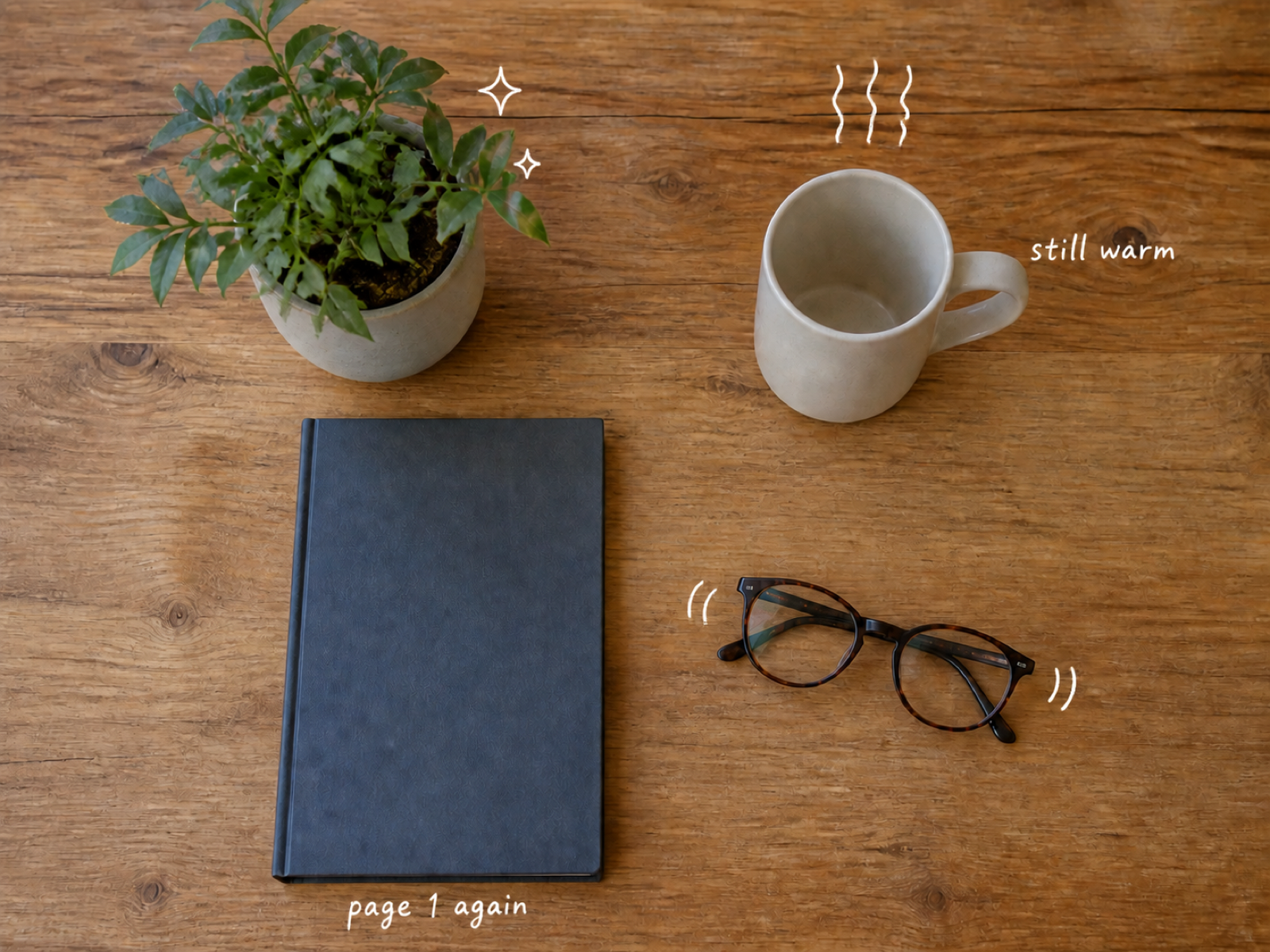

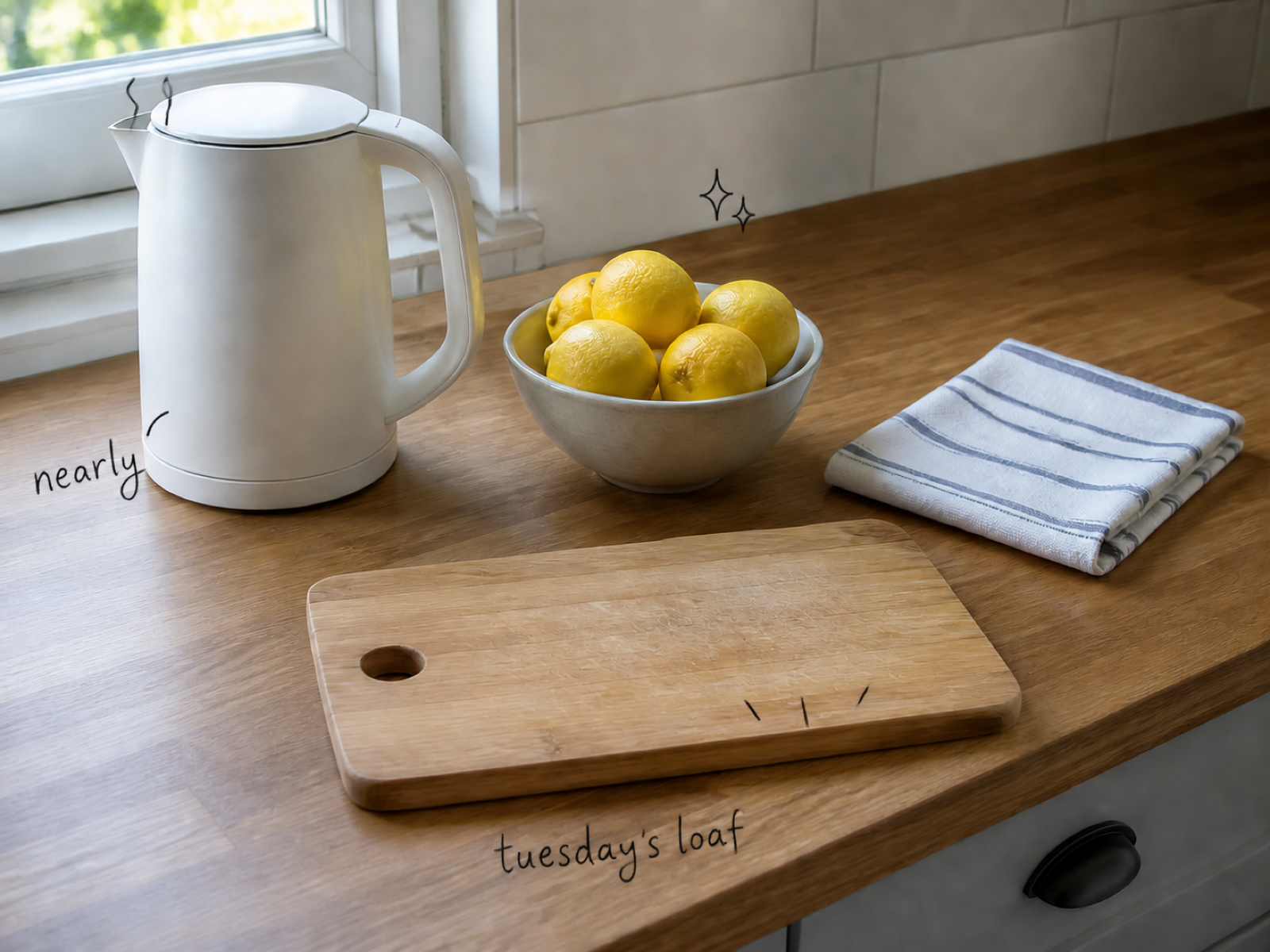
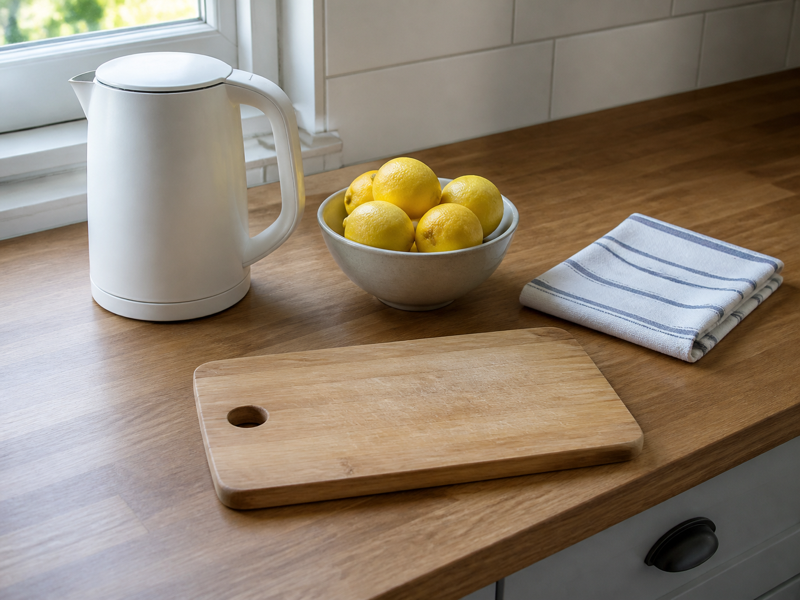
One treatment, two different photographs. A desk and a kitchen worktop, one drawn in white and one in charcoal. Both photographs hold more nameable things than the fields named, and neither result has a mark on anything that was not asked for.
Both runs pass on every rule this template adds, which is worth saying plainly because it is the first pair in this set that does. Each mark is attached to a thing the field named and does the job it was given — three steam curls off the mug, two sparkles at the plant, a short arc either side of the glasses — and the counts match the pairs exactly, with no stars in the corners and no confetti. The photographs underneath are untouched: same crop, same light, same colour, nothing retouched or cleaned. And the writing is the writing that was typed, in its stated places, which is the whole point of the wash. The reference this came from instructs the run to invent its own captions and explicitly forbids fixed phrases, so a picture put through it comes back with a stranger's joke on it in a language nobody chose. Ours writes nothing it was not given, and an empty third field returns a picture with no handwriting at all.
Generated for this library
Input
  Draw on     the mug: three steam curls rising · the
              plant: two small sparkles at the leaves ·
              the glasses: a short motion line either side
  Pen         a thin white marker, one weight throughout
  Words       beside the mug still warm · under the
              notebook page 1 again
  Photograph  desk.png (1254 x 940)

Returned   1 image · 4:3 · the photograph, drawn on

photo      untouched - same crop, same light, same
           colour, nothing retouched underneath
marks      three pairs named, three marks drawn - curls
           on the mug, sparkles at the plant, arcs at
           the glasses, nothing floating anywhere
pen        one white line at one weight, flat, no glow
           and no shadow
words      the two given, in their two places - nothing
           the field did not say
covered nothing - every mark sits beside its thingYou fill in 3 fields — the braced lines at the top. Everything below them is fixed.
- 1What to draw on, and what each doodle does
- 2The pen it is drawn with
- 3The words, and where each one goes
Drawn On, Not Drawn In
What this makes
Hand it a photograph and it draws over the top of it — every doodle attached to a thing you named and doing one job to it, the photograph underneath untouched. Three fields.
You are given ONE photograph. Return ONE image: the same photograph, untouched, with drawing added on top of it. Follow every line. Replace only the FIELDS block; everything after it is fixed.
First — do you have the photograph and the fields?
Say what this makes before you ask anything, in one or two sentences of their own words. Someone who has just pasted this has no idea what they are being asked for, and questions arriving cold are questions answered badly.
If no photograph is attached, stop and ask for one. There is nothing to draw on without it.
If any field below still has braces around it, stop and ask. Put all the questions in one short message, and show the example under each one so they can see the shape of a useful answer. Wait for the replies, then work. Never fill a brace yourself.
Ask in whatever language they are writing to you in. Translate the questions and the examples; do not make someone read English to tell you what they want.
If the photograph is attached and the fields are filled in, ignore this and carry on.
Fields — replace these three lines only
- What to draw on, and what each doodle does: {a thing, then its doodle, one pair at a time}
- The pen it is drawn with: {an ink, a weight}
- The words, and where each one goes: {the exact words and their places, or the word none}
The law everything else follows from
The photograph is not touched. Everything added sits on top of it and looks it.
Nothing underneath is relit, recoloured, cropped, cleaned, sharpened or moved. The marks are a layer, and the whole point of the genre is that a viewer can see it is a layer: a photograph with something drawn on it is charming, and a photograph with something blended into it is a retouching job pretending to be one.
Every mark is attached
Each doodle belongs to one thing named in the first field, and does the one job that field gives it.
- The number of doodles equals the number of pairs in the field. Not more.
- A doodle sits against its thing — touching it, tracing it, rising from it, running beside it — so a viewer can say what it is drawn on without being told.
- No mark that belongs to nothing: no stars in the corner, no random squiggles, no confetti, no sparkle field, no border of marks.
The test is the same count as before. Read the field's pairs, then point at each mark. Every pair has one mark; every mark has one pair. Marks with nothing to belong to are the failure this genre has, and they arrive because a template asked for playfulness instead of asking for a job.
The pen
- One ink and one weight, as the second field says, throughout.
- Hand-drawn: the line wobbles slightly, ends are not perfectly closed, a stroke sometimes overshoots.
- Flat. No shading, no gradient, no glow, no drop shadow, no emboss, no 3D. A mark has no light on it, because it is not in the scene.
- Marks may cross each other. They may not be so dense that they read as texture.
What may not be covered
- No mark crosses a face, or any lettering already in the photograph.
- No mark crosses the subject's own outline in a way that breaks it — a doodle may touch an edge and sit beside it, not paint over it.
- Nothing in the photograph is hidden. If a doodle has nowhere to go without covering something, make it smaller, not bolder.
The words
Only the words the third field gives, exactly as it gives them, in the places it gives them.
Written in the same pen as the marks, small, and set beside the thing they refer to rather than across it.
The reference this was rewritten from instructs the run to write its own captions — to avoid fixed phrases and generate humorous, context-aware text for each image. That is how a stranger's joke ends up on a reader's photograph, in a language nobody chose. Here, an empty third field means no writing at all.
Never
- A word, a letter or a number the third field did not give, in any script.
- A doodle that is not paired with a thing in the first field.
- Any change to the photograph underneath, including cropping, straightening, brightening or removing something.
- A frame, a border, a sticker, a watermark, a filter or a texture over the whole image.
- Marks in a second colour or a second weight.
What it should read as
Someone's photograph with someone's biro on it — the picture exactly as it was taken, and a few marks that plainly happened afterwards.
The whole template, in one piece. The steps below are the entire workflow.
How to use it
- Copy the whole template with the button above.
- Attach your photograph and paste the template in the same message.
- Replace the three FIELDS lines. In the first, name the thing and then what its doodle does — that pairing is what stops marks floating.
- Check that every mark has a thing before shipping, and that nothing you care about in the photograph is covered.
- Write the words yourself in the third field, in whatever language you want them. Anything you do not write does not appear.
What you swap
- What to draw on, and what each doodle does
- the mug: three steam curls rising · the plant: two small sparkles at the leaves · the glasses: a short motion line either side
- The pen it is drawn with
- a thin white marker, one weight throughout
- The words, and where each one goes
- beside the mug still warm · under the notebook page 1 again
Before it runs
- An actual photograph, attached to the message. This draws on a picture, so there has to be a picture.
- Things worth naming, and space beside them. A doodle needs somewhere to sit that is not on top of the subject, so a frame filled edge to edge leaves nowhere to draw.
- One job per doodle, decided by you. 'Make it playful' returns marks scattered wherever they fit; 'the mug: three steam curls rising' returns a doodle that belongs to the mug.
- Your own words, or none. The template will not write anything, which means an empty third field comes back as a picture with no handwriting on it at all.
When to reach for it
When a flat photograph needs to become something you would actually post: a shop's own picture, a card, a story frame. Templates in this genre scatter marks across the frame and then, because they are told to, invent handwriting to go with them — so the picture comes back with a joke in it that nobody wrote.
What changes
- One photograph in, one out — the photograph itself untouched, with drawing on top of it.
- Every doodle is attached to a thing you named and does the one job you gave it, so nothing floats.
- The marks read as marks: one ink, one weight, no shading, no glow, nothing pretending to be part of the photograph.
- The only handwriting is the handwriting you wrote — the reference template is instructed to invent it, and this one is forbidden to.
- Nothing underneath is hidden: no doodle crosses a face, a label or the subject's own edge.
Pairs with
- A Grade Moves No ShadowHand it a snapshot and it comes back graded — a named contrast curve, a named colour split, halation and grain — with every object, every shadow and the whole framing exactly where they were. Two fields.
- A Hole Has No Focal PlaneHand it a photograph and it takes the picture again through a pinhole — no lens, so nothing is ever truly sharp and nothing is ever more blurred than anything else, with the corners falling away because of simple geometry. Two fields.
- A Line at a Constant HeightHand it a photograph and it comes back as contour lines — every line a closed loop at one depth, none of them crossing, none of them stopping in mid-air, with the spacing doing all the shading. Two fields.