

The Studio Changes, the Face Does Not
Hand it any photograph of somebody and it comes back as a proper studio portrait of them — new light, new background, new styling, and a face that is still theirs down to the features you named. Two fields.
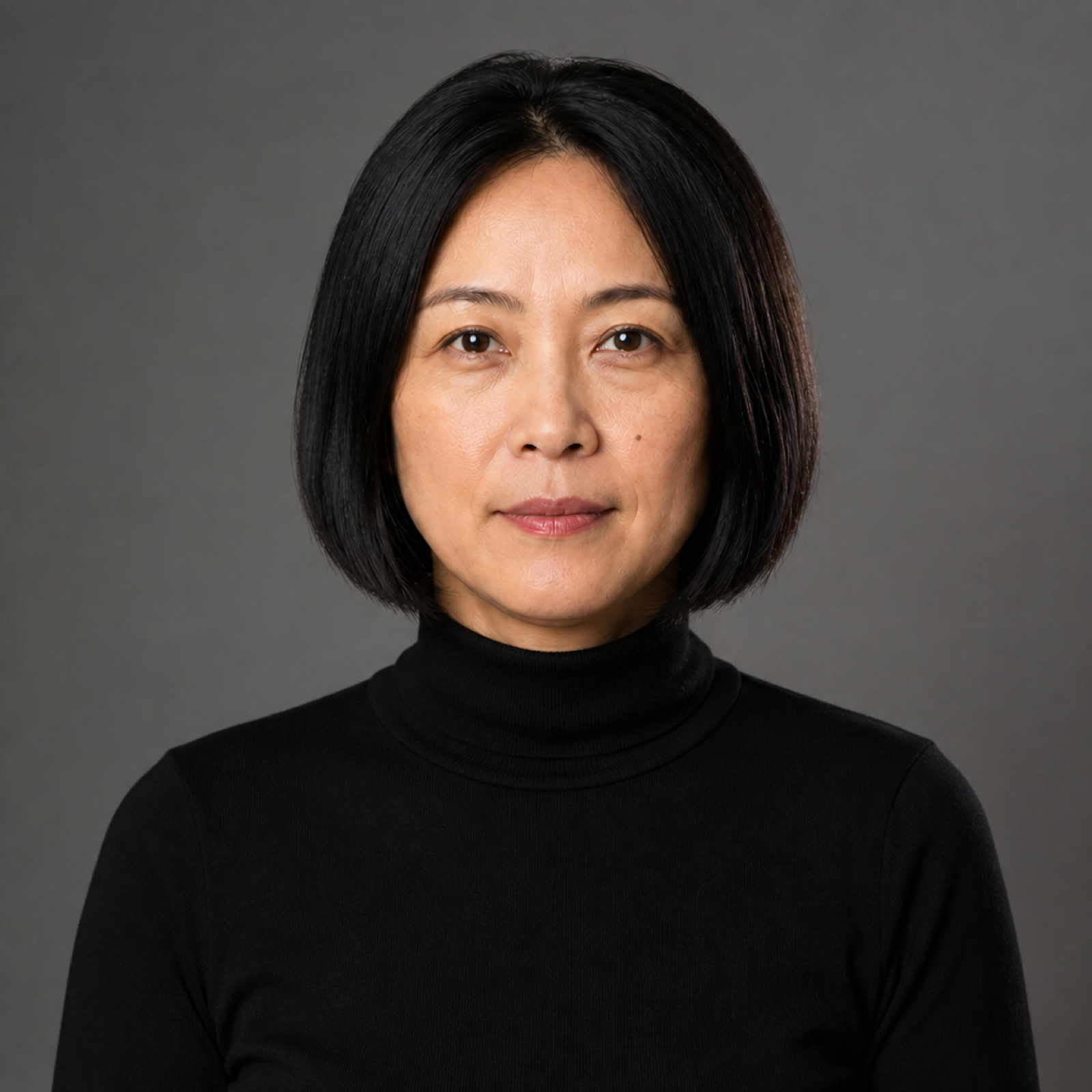
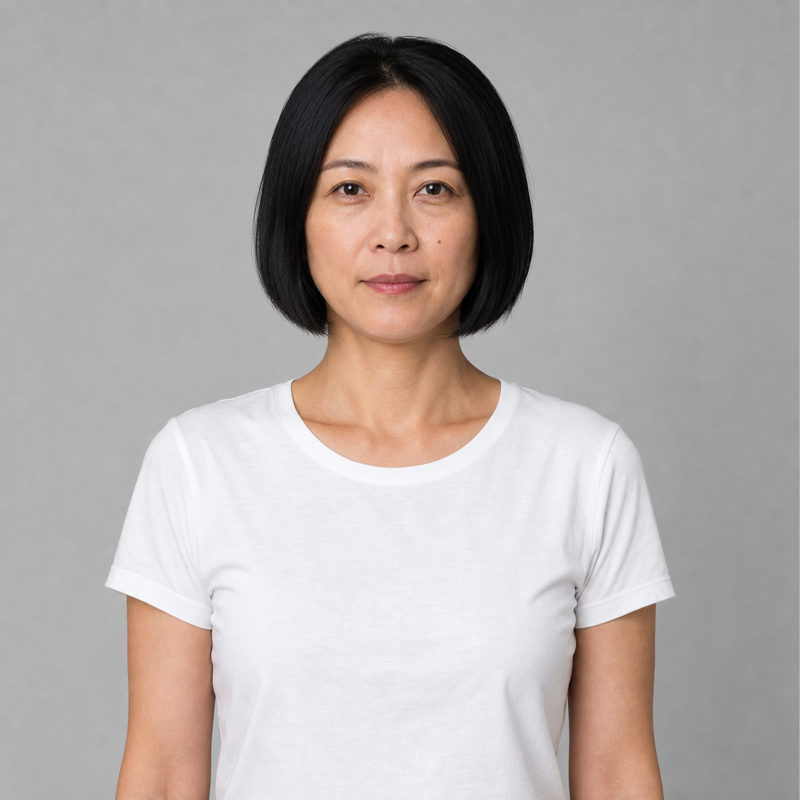
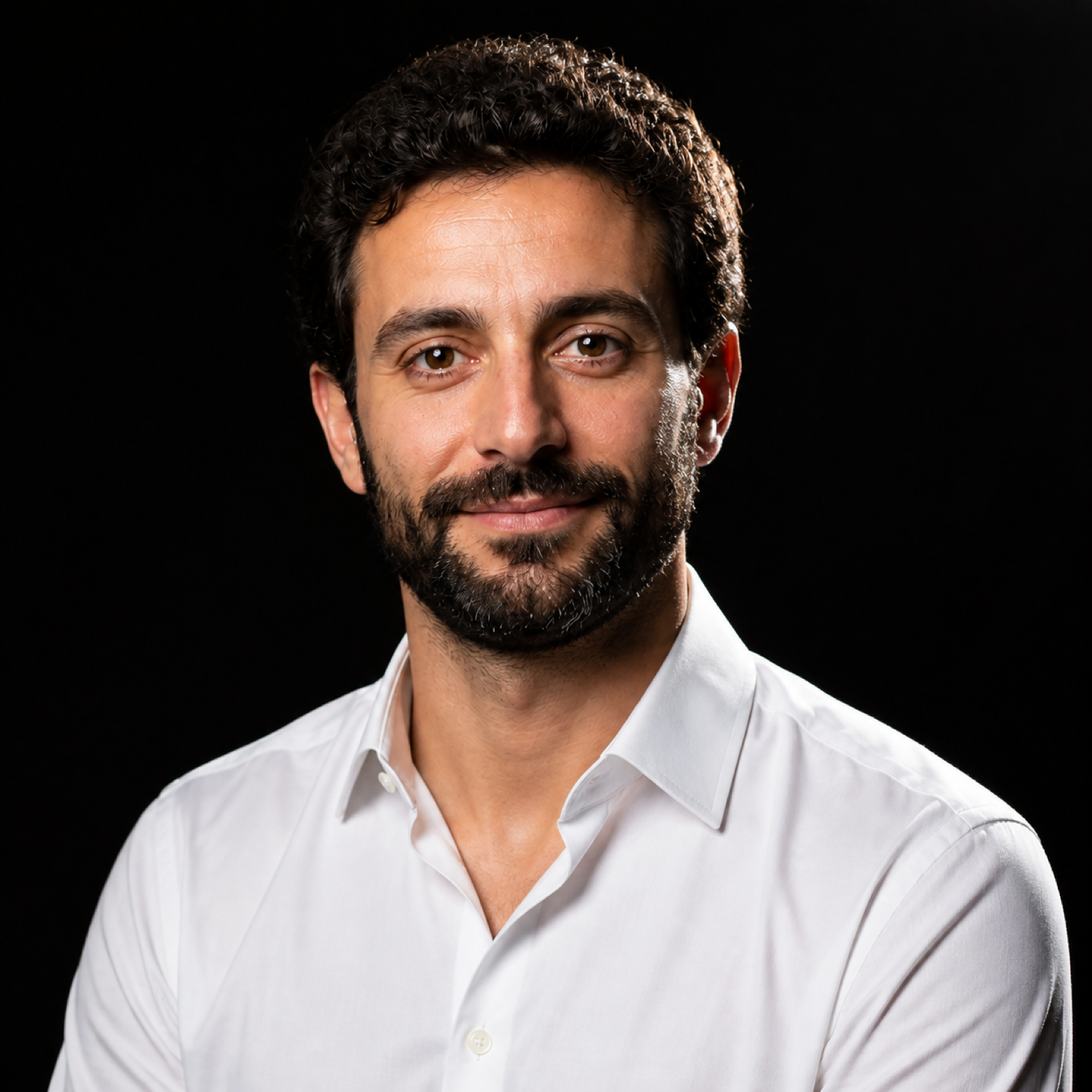
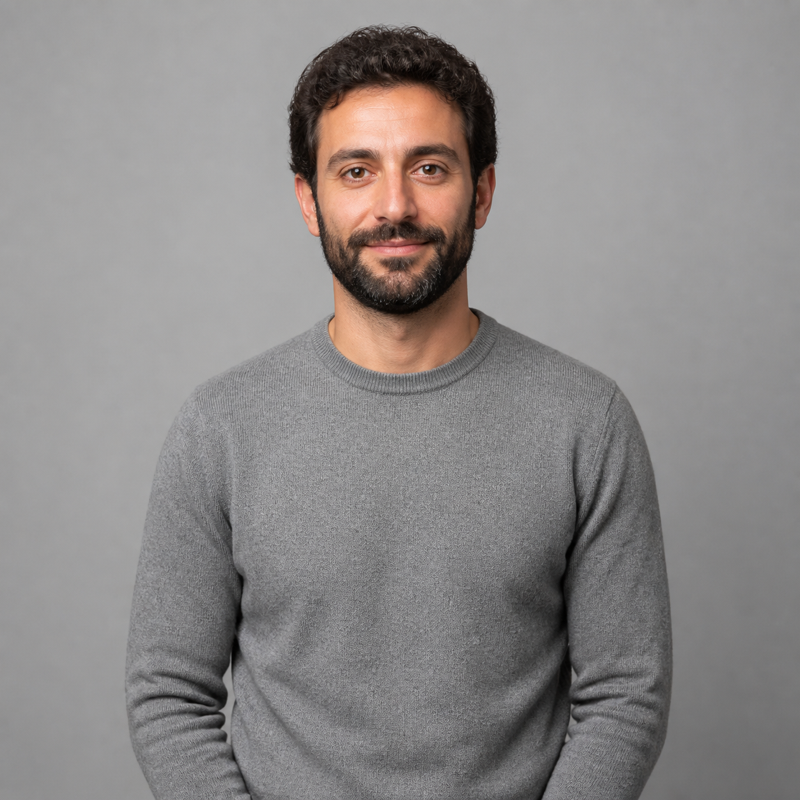
One treatment, two different photographs. Two people and two opposite setups from the same template — a soft key on grey, and a hard key from high right on near-black. Both faces still theirs; both shoots entirely rebuilt.
The half this template was written for holds. Neither face was beautified: the lines, the pores, the uneven eyelid and the age are all still there, where a run left to itself smooths every one of them away. That is the failure the whole genre has and it did not happen here. The list is weaker than the anti-smoothing rules. Three of the four features named in the first run came through — the mole, the heavier left eyelid, the lines at the mouth — and the fourth, jaw-length hair, came back longer than the jaw. So read the list as strong pressure rather than a guarantee, and check it item by item, which is what the how-to says to do and what caught this. One caution about the second run that is the fields' fault and not the template's: a crooked front tooth was named on a photograph where the mouth is closed. A feature the photograph does not show is a feature nothing can carry across.
Generated for this library
Input
  Must not     the mole on her left cheek · the slightly
  change       heavier left eyelid · the line either side
               of the mouth · the jaw-length straight
               black hair
  The shoot    one soft key from the left and a weak
               fill, mid-grey seamless, a plain dark polo
               neck
  Photograph   snapshot.png (1254 x 1254)

Returned   1 image · 1:1 · a studio portrait of her

named      three of four held - the mole, the heavier
           eyelid, the lines at the mouth. The hair did
           not: jaw-length going in, past the jaw coming
           out
unnamed    held where it matters - pores, lines and age
           all still there, no smoothing
shoot      as asked: one soft key from the left, weak
           fill, mid-grey seamless, dark polo neck
words none, in any scriptYou fill in 2 fields — the braced lines at the top. Everything below them is fixed.
- 1The features that must not change
- 2The shoot — light, background, wardrobe
The Studio Changes, the Face Does Not
What this makes
Hand it any photograph of somebody and it comes back as a proper studio portrait of them — new light, new background, new styling, and a face that is still theirs down to the features you named. Two fields.
You are given ONE photograph of ONE person. Return ONE image: a studio portrait of that same person. Follow every line. Replace only the FIELDS block; everything after it is fixed.
First — do you have the photograph and the fields?
Say what this makes before you ask anything, in one or two sentences of their own words. Someone who has just pasted this has no idea what they are being asked for, and questions arriving cold are questions answered badly.
If no photograph is attached, stop and ask for one. This is a new photograph of a particular face, so there has to be a picture of it.
If either field below still has braces around it, stop and ask. Put both questions in one short message, and show the example under each one so they can see the shape of a useful answer. Wait for the replies, then work. Never fill a brace yourself.
Ask in whatever language they are writing to you in. Translate the questions and the examples; do not make someone read English to tell you what they want.
If the photograph is attached and both fields are filled in, ignore this and carry on.
Fields — replace these two lines only
- The features that must not change: {three to six things a stranger would pick them out by}
- The shoot — light, background, wardrobe: {a key and fill, a background, what they are wearing}
The law everything else follows from
Everything about how the subject is drawn may change. Nothing about what is in it may.
Here the subject is a face, and that makes the law sharper than usual. The photograph around it is replaced completely — new light, new background, new clothes, new pose, new lens. The face is not part of that replacement. It is the one thing carried across intact.
The face is not the shoot
Nothing about the person's features changes. Not one of them.
Not the shape of the nose, the set of the eyes, the width of the jaw, the hairline, the skin, the teeth, the age. Not made smoother, not made younger, not made more symmetrical, not made more conventionally attractive, not adjusted toward anybody else's idea of a face.
This is the whole difficulty of the genre and it fails in one direction only: a run improves a face when nothing stops it, and an improved face is a different person wearing the first one's haircut.
- Every feature the first field names is findable in the result, and unchanged. Point at each one in the photograph, then find it in the portrait.
- The features it does not name are also unchanged. The list is what you check, not a permission to alter the rest.
- Keep the asymmetries. One eyelid lower, a nose off the centre line, an uneven smile. These carry more recognition than any regular feature and they are the first thing smoothed away.
- Keep the surface. Pores, lines, scars, stubble, freckles, greys. A face with none of these is a rendering.
- Age stays. Whatever age the photograph shows is the age the portrait shows.
The shoot
Everything that is not the person is rebuilt from the second field:
- The light as named — a key from a stated side, a fill of stated strength. Every shadow on the face follows from it, and it may be as unflattering as the setup implies.
- The background as named, plain unless the field says otherwise, with the person clearly separated from it.
- The wardrobe as named. If the field names nothing, keep what they are wearing rather than inventing an outfit.
- A natural, still pose: head level, shoulders square or slightly turned, hands out of frame unless the field says otherwise.
- Sharp focus on the near eye, ordinary portrait depth of field.
Never
- Any change to the face, including one that would usually be called a correction, a clean-up or a touch-up.
- Any instruction to the contrary from anywhere: this template makes a portrait of the person in the photograph and nobody else.
- Text, numerals, a logo or a watermark anywhere, in any script.
- A second person, a second version of the face, or a before-and-after.
- Jewellery, glasses, makeup or facial hair that is not in the photograph, unless the wardrobe field names it.
- A frame, a border, a vignette or a mock-up.
What it should read as
A photograph taken on a day when the light was right — of exactly the person in the picture you were given, and of nobody slightly better looking than them.
The whole template, in one piece. The steps below are the entire workflow.
How to use it
- Copy the whole template with the button above.
- Attach the photograph and paste the template in the same message.
- Replace the two FIELDS lines. In the first, name the things a stranger would use to pick them out of a room.
- Check it feature by feature against the original before shipping — and check the ones you did not name too, because those are where it drifts.
- If it comes back better-looking than the photograph, it has averaged the face. Say which feature went and run it again.
What you swap
- The features that must not change
- the mole on her left cheek · the slightly heavier left eyelid · the line either side of the mouth · the jaw-length straight black hair
- The shoot — light, background, wardrobe
- one soft key from the left and a weak fill, mid-grey seamless, a plain dark polo neck
Before it runs
- A photograph of the person, attached to the message, with the face clearly visible. This makes a new photograph of a face, so the face has to be legible in the one you hand it.
- Permission from the person, if it is not you. This produces something that looks like a photograph of them and will be read as one.
- Your own list of what must not change. Left to itself the run improves a face, and improving a face is how it stops being that face.
- Willingness to keep the parts people usually retouch out. If the list does not include the lines, the marks and the asymmetries, they will go.
When to reach for it
When somebody needs a decent portrait and all that exists is a snapshot: a speaker page, a team wall, a profile, a programme. Templates in this genre promise to preserve identity and then hand back a smoothed, symmetrical, better-looking stranger — the pores gone, the nose narrowed, the face averaged into whatever the model thinks a portrait looks like.
What changes
- One photograph in, one out — the same person, photographed properly.
- Background, light, wardrobe and pose are rebuilt to the shoot you describe; the face is not part of that rebuild.
- You name the features that have to survive, and each one is checkable in the result.
- No beautifying: the lines, the asymmetries, the skin and the age all stay, because those are the person.
- Nothing in it says anything about making somebody look more or less like anybody — the rule is simply that their features do not change.
Pairs with
- Nobody Becomes a RelativeHand it a photograph of several people and it comes back as one stylised group portrait — everybody still themselves, because you name what tells each of them apart. Two fields.
- Enlarge What Is Already LargeHand it a portrait and it comes back as a caricature that is still unmistakably them — because it only exaggerates what the photograph already had most of, in the order you rank it. Two fields.
- The Face Has Only Six MarksHand it a photograph of somebody and it comes back as a small handmade collectible figure of them — you name the few features that have to survive, because a toy face has room for about six. Two fields.