
The Dot Changes Size, the Ink Does Not
Hand it a photograph and it comes back as a printed halftone — one ink, one screen angle, tone carried entirely by how big the dots are, with the coarseness set against something in the picture. Two fields.
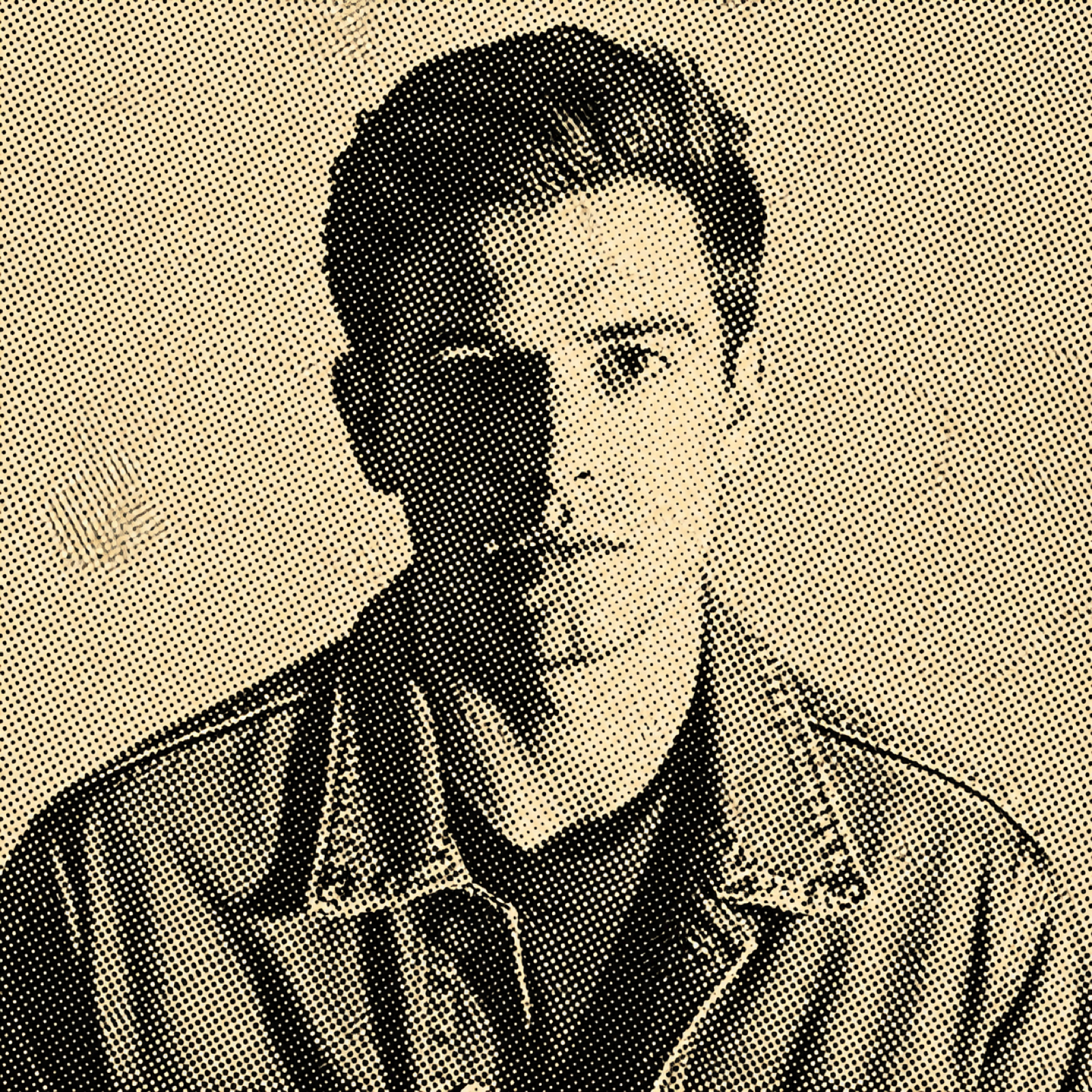

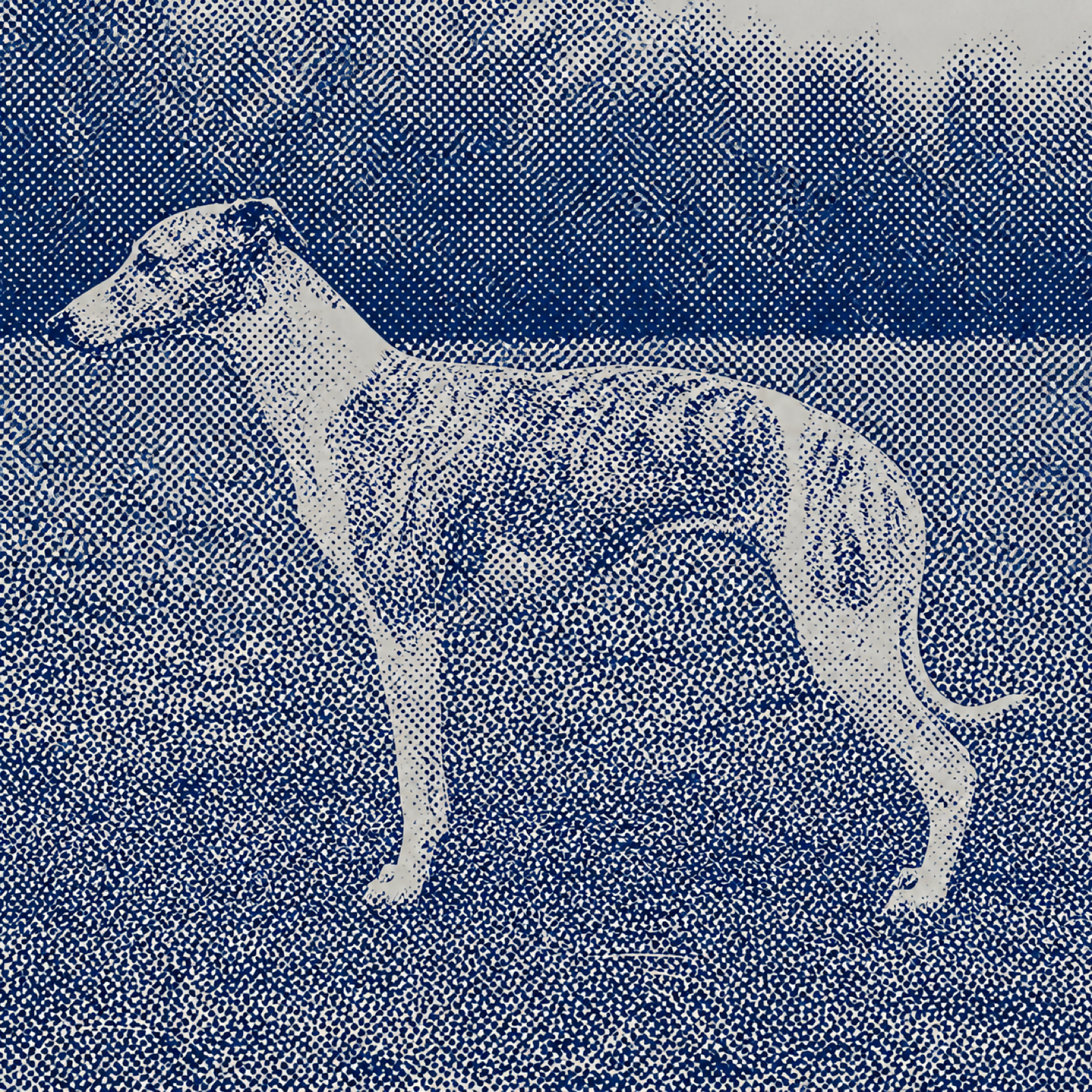
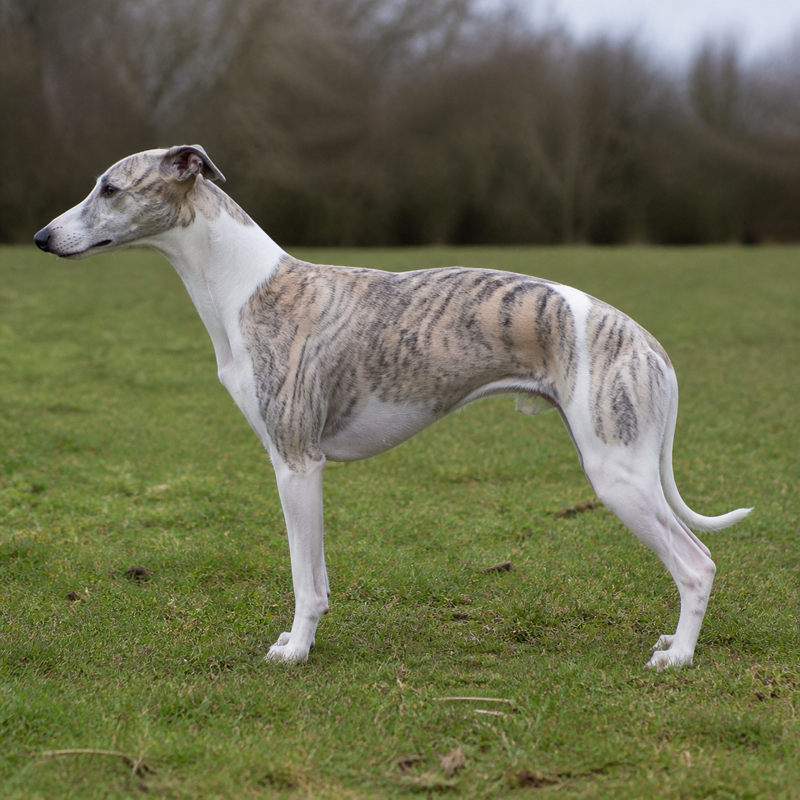
One treatment, two different photographs. A portrait in black on newsprint and a dog in blue on grey — and the second one is where the grid gives way, which is the more useful of the two pictures.
The first run is what the rewrite is for. Zoom into all four corners and the dots sit on one lattice at one angle and one pitch; they grow with the tone and merge into solid ink in the shadows, leaving the paper showing as small white dots — the inversion a press actually does. One ink at one strength, no grey, and the eyelashes and topstitching are simply gone because five dots across an eye cannot hold them. The second run shows where this breaks, and it is worth more than another success. The top of the picture is a proper screen; the grass at the bottom has lost the lattice completely and become a random stipple with no angle and no pitch. The photograph is the reason: where its own detail is about the same size as the screen, the run draws the texture instead of screening it. That is why the straight-edge check is in the steps above — compare two far-apart corners, not one. The same run also ignored a pitch finer than the picture's own detail: it was asked for four dots across a single brindle stripe, and the brindle is gone altogether. Ask for a screen coarser than the thing you are screening.
Generated for this library
Input
  Coarseness  coarse - about six dots across the width of
              an eye
  Ink/paper   one black ink on warm off-white newsprint
  Photograph  portrait.png (1254 x 1254)

Returned   1 image · 1:1 · a screened portrait

values     one ink, one strength - dots grow and merge
           into solid, and in the darkest parts the
           paper is left as small white dots
grid       one lattice at one angle; the straight-edge
           test passes in all four corners
pitch      about five dots across the eye against the
           six that were asked for
detail     eyelashes, stubble and the jacket's topstitch
           all gone, as the pitch requires
words none, in any scriptYou fill in 2 fields — the braced lines at the top. Everything below them is fixed.
- 1How coarse the screen is, measured against something in the picture
- 2The ink and the paper
The Dot Changes Size, the Ink Does Not
What this makes
Hand it a photograph and it comes back as a printed halftone — one ink, one screen angle, tone carried entirely by how big the dots are, with the coarseness set against something in the picture. Two fields.
You are given ONE photograph. Return ONE image: that photograph printed as a halftone. Follow every line. Replace only the FIELDS block; everything after it is fixed.
First — do you have the photograph and the fields?
Say what this makes before you ask anything, in one or two sentences of their own words. Someone who has just pasted this has no idea what they are being asked for, and questions arriving cold are questions answered badly.
If no photograph is attached, stop and ask for one. This screens a particular picture; there is nothing to screen without it.
If either field below still has braces around it, stop and ask. Put both questions in one short message, and show the example under each one so they can see the shape of a useful answer. Wait for the replies, then work. Never fill a brace yourself.
Ask in whatever language they are writing to you in. Translate the questions and the examples; do not make someone read English to tell you what they want.
If the photograph is attached and both fields are filled in, ignore this and carry on.
Fields — replace these two lines only
- How coarse the screen is, measured against something in the picture: {a count of dots across a named thing}
- The ink and the paper: {one ink, or two, and what it is printed on}
The law everything else follows from
Everything about how the subject is drawn may change. Nothing about what is in it may.
The rendering becomes a printed screen. What is in the picture does not move: same subject, same pose, same framing, same relative sizes, same number of things. It is that photograph, printed.
The ink has one density; only the dot changes size
This is the whole rewrite, and it is one sentence about a press.
A press lays one ink at one strength. It cannot print a weaker black. Tone is faked by covering more or less of the paper: a light area is small dots with a lot of paper showing, a dark area is fat dots that have grown until only small gaps of paper are left. So:
- Every point in the picture is either full-strength ink or bare paper. No grey, no tint, no soft shadow, no blur, no gradient fill.
- Dots grow and shrink; they never fade. A dot at the edge of a shadow is small and solid, not large and pale.
- Around the middle of the range the dots touch, making a chequered mesh. That band is the loudest texture in the print and it should be visible where the picture is mid-toned.
- In the darkest areas the ink is solid and the remaining paper shows as small white dots — the pattern inverts, which is what a press does.
If the result has grey in it, the screen has been laid over a photograph instead of replacing it.
One grid, one angle, everywhere
- The dots sit on a regular lattice at a single angle across the entire image. Traditionally somewhere near 45 degrees; whatever you pick, it is the same in every corner.
- The pitch never changes. The grid does not get finer in the face and coarser in the background, and it does not follow a contour.
- The subject does not bend the grid. No swirling, no radiating, no dots stretched along a form.
- A second ink, if the field names one, gets its own angle, offset from the first by roughly thirty degrees, and may be a hair out of register — a thin fringe of one colour along one side of a shape.
The pitch decides the detail
The first field sets how big the dots are relative to the picture. Everything follows from it:
- Nothing smaller than about two dots can exist. At a coarse screen, eyelashes, whiskers, thin wires, fine lettering and skin texture are simply gone. Do not draw them in another way.
- Small features become their overall tone. An eye at six dots wide is a dark cluster with one paper-coloured dot in it.
- The count of things stays right. Detail may go; objects may not.
The ink and the paper
- Printed in the ink the second field names, at that ink's full strength and no other value of it.
- On the paper it names, whose colour is the picture's only other value.
- The paper's colour shows through everywhere the ink is not, which is what ties the print together.
Never
- Text, numerals, a signature, a caption or a watermark anywhere, in any script.
- Grey, blur, glow, drop shadows, gradients or airbrush.
- A dot pattern sitting on top of a photograph that is still visible underneath.
- A border, a frame, a torn edge, a paper mock-up or a hanging poster.
- A subject the photograph did not contain.
What it should read as
Something printed rather than filtered — from a distance a picture, and up close nothing but dots and paper.
The whole template, in one piece. The steps below are the entire workflow.
How to use it
- Copy the whole template with the button above.
- Attach the photograph and paste the template in the same message.
- Replace the two FIELDS lines. Pick the thing you measure the dots against from the picture itself — an eye, a window, a wheel.
- Check the grid: put a straight edge along the dots in two far-apart corners. If the angle differs, the screen has followed the subject and the print is fake.
- Look for grey. A halftone that has grey in it has been drawn rather than screened.
What you swap
- How coarse the screen is, measured against something in the picture
- coarse — about six dots across the width of an eye
- The ink and the paper
- one black ink on warm off-white newsprint
Before it runs
- A photograph, attached to the message, with a real range of tone in it. A flat, evenly lit picture halftones into an even field of identical dots and says nothing.
- A size, not a word. 'Coarse' and 'fine' mean nothing to a run with no ruler; six dots across an eye is a measurement it can act on.
- Acceptance that fine detail goes. Anything smaller than about two dots cannot be represented, so a coarse screen eats eyelashes, text, and thin wires.
- One ink, or two named ones. This is a press, not a printer — every extra colour is another pass and another screen angle.
When to reach for it
When something should look like it came off a press: a zine, a poster, a band shirt, a newspaper pastiche, a risograph run. Templates in this genre ask for a halftone effect and give you a soft grey photograph with a dot pattern sitting on top of it, which is two renderings at once and reads as neither.
What changes
- One photograph in, one halftone out — every point is ink or paper, nothing in between.
- The dot grid stays at one angle and one pitch across the whole picture instead of following the subject.
- You set the coarseness against something visible in the frame, so it is a size and not an adjective.
- Highlights are small dots on bare paper, shadows are small gaps in solid ink, and the noisiest band is the middle.
- One image, no type, no border, no paper mock-up.
Pairs with
- The White Is What Was Cut AwayHand it a photograph and it comes back as a woodcut — no grey anywhere, every middle tone made out of parallel cuts spaced wide or close, because a block can only print ink or nothing. Two fields.
- A Grade Moves No ShadowHand it a snapshot and it comes back graded — a named contrast curve, a named colour split, halation and grain — with every object, every shadow and the whole framing exactly where they were. Two fields.
- A Hole Has No Focal PlaneHand it a photograph and it takes the picture again through a pinhole — no lens, so nothing is ever truly sharp and nothing is ever more blurred than anything else, with the corners falling away because of simple geometry. Two fields.